
mRNA Localization of Nuclear Import Proteins Exhibit Variable Behavior Between C. Elegans and Human Cells
Category: Research Poster
Author(s): Nora Tayefeh
Presenter(s): Nora Tayefeh
Mentors(s): Ambika Basu
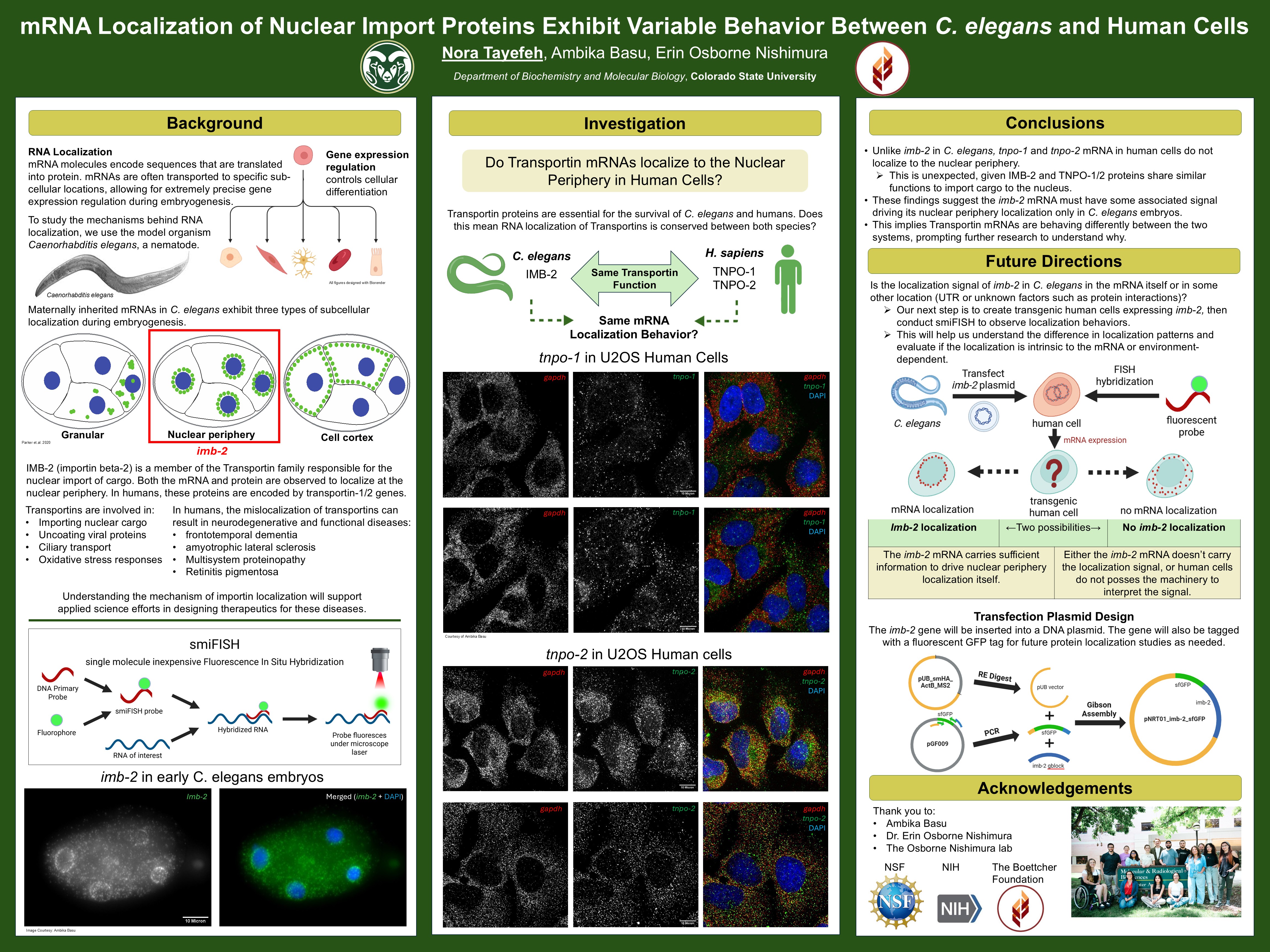
Gene expression regulation controls the translation of genes into proteins both spatially and temporally. An important yet relatively understudied mechanism of gene expression control is subcellular mRNA localization, with major roles in developmental and cellular functions. Previous research from our lab has discovered that imb-2 (Importin beta-2) mRNA concentrates around the nuclear periphery during Caenorhabditis elegans embryogenesis in a translation-dependent manner. To investigate if nuclear periphery mRNA localization is important in human biology, we investigated the localization of human homologs of imb-2. Two homologs of imb-2 exist in humans, tnpo-1 and tnpo-2 (transportin-1/2), whose proteins serve similar roles of importing cargo to the nucleus. Therefore, the mRNA would also be expected to localize to the nucleus like in C. elegans. To determine the location of these mRNAs, we used fluorescence microscopy on fixed human cells. Both tnpo-1 and tnpo-2 did not concentrate around nucleus therefore nuclear periphery localization is not a conserved phenomenon. This suggests that the imb-2 mRNA must have some associated signal that is driving its nuclear periphery localization in C. elegans embryos. We speculate this localization is either directly or indirectly linked to its encoded protein function. Our next step is to create transgenic human cells expressing imb-2 and observe if the mRNA has sufficient information to drive nuclear periphery localization itself.