
Synthesis and Characterization of Electronically Tunable Tin Perovskites
Category: Research Poster
Author(s): Jenni Taylor
Presenter(s): Jenni Taylor
Mentors(s): Autumn Peters, James Neilson
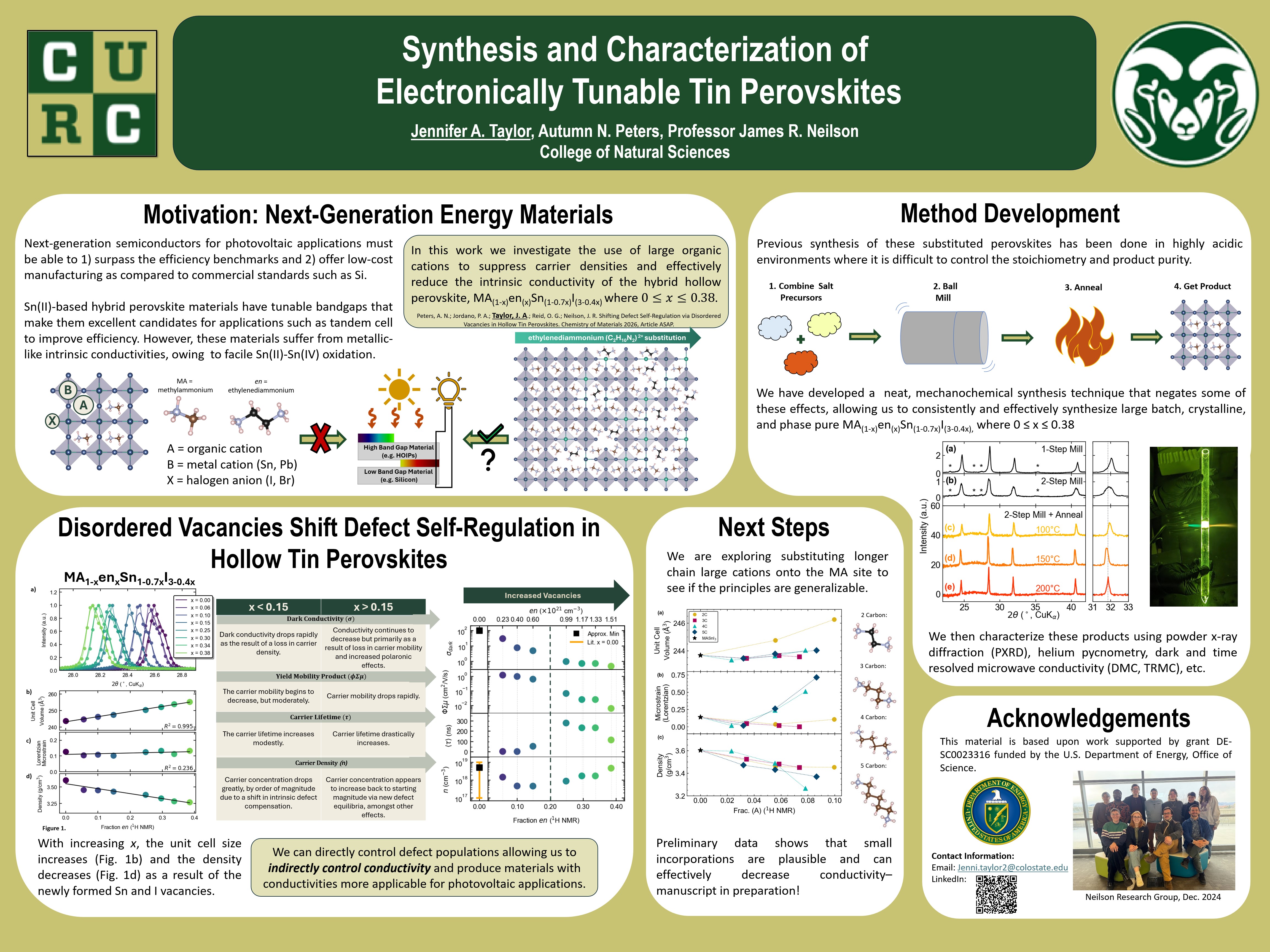
Tin-based hybrid organic inorganic perovskites have emerged as next-generation semiconductors for photovoltaic applications. However, Sn(II)-based hybrid perovskites have high intrinsic carrier concentrations, limiting their applications. We have successfully synthesized the hybrid perovskite family, MA(1-x)en(x)Sn(1-0.7x)I(3-0.4x) (MA=methylammonium, en=ethylenediammonium, 0 ≤ x ≤ 0.38) using neat, mechanochemical synthesis. We see that en is able to in part substitute onto the MA site, resulting in tin and iodide vacancies to charge and size accommodate the larger cation. Consequently, we demonstrated through dark and time-resolved microwave conductivity experiments that when x ≤ 0.15 the carrier concentration is decreased by order of magnitude, resulting in decreased conductivity values more reasonable for photovoltaic applications. Thus, we have resolved a technique to effectively reduce the intrinsically high carrier concentration in this Sn(II)-based perovskite and can intentionally control defects to indirectly manipulate conductivity. Currently, we are using this synthetic technique to trial 3 new large cations in this system: DAP=1,3-diaminopropane, BDA=1,4-butanediamine, and PDA=pentane-1,5-diamine. When these are substituted onto the MA site, preliminary studies have shown that small incorporations (x ≤ 0.05) can effectively reduce conductivity.