
The impact of HEC1 tail contacts with microtubules on kinetochore-microtubule attachment stability
Category: Research Poster
Author(s): Fiona Miller
Presenter(s): Fiona Miller
Mentors(s): Jennifer DeLuca
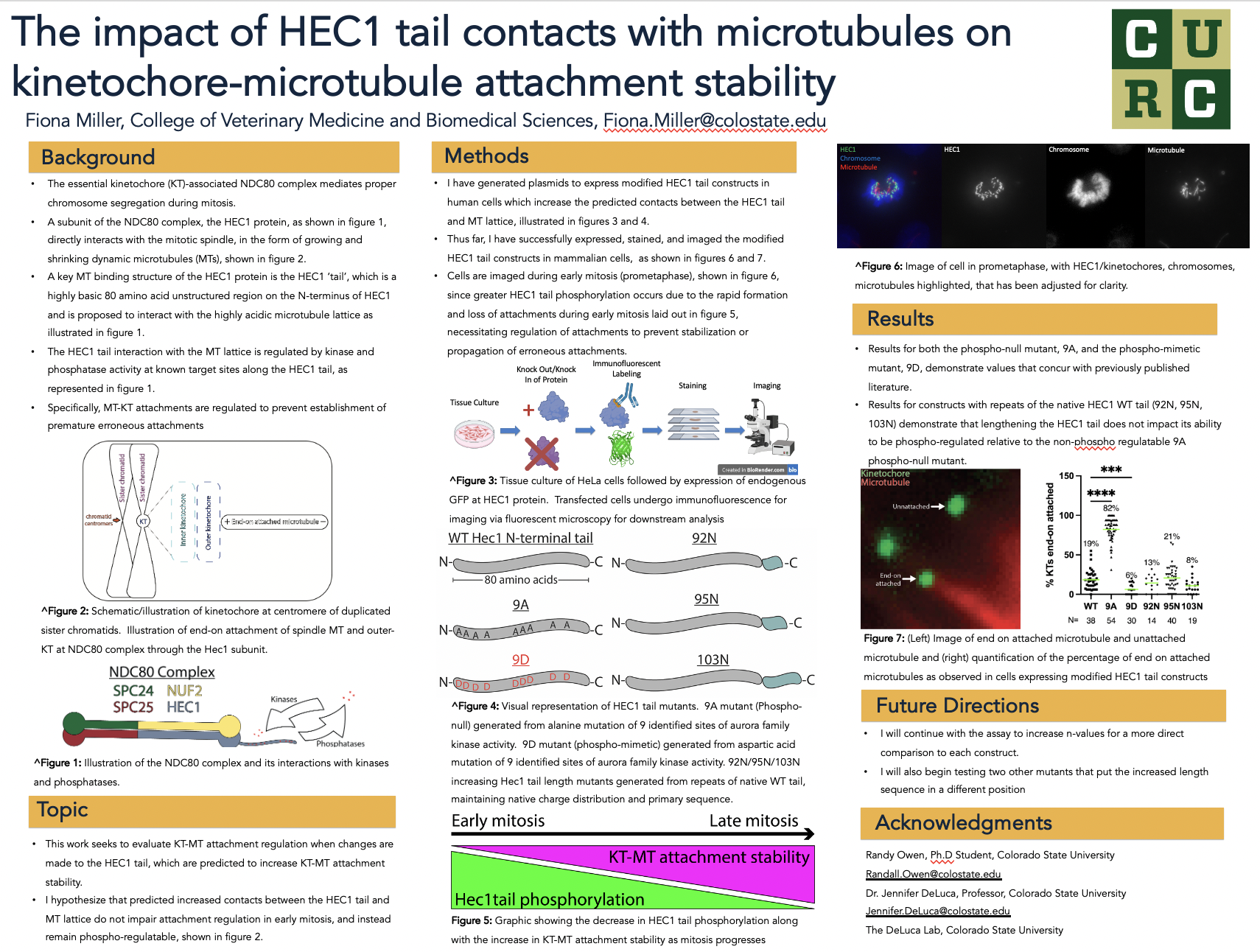
The essential kinetochore (KT)-associated NDC80 complex mediates proper chromosome segregation during mitosis. Improper segregation of genetic material can contribute, if not corrected, to chromosome instability. A subunit of the NDC80 complex, the HEC1 protein, directly interacts with the cytoskeletal protein, tubulin, in the form of growing and shrinking dynamic microtubules. A key MT binding structure of the HEC1 protein is the HEC1 ‘tail’, which is a highly basic 80 amino acid unstructured region on the N-terminus of HEC1 and is proposed to interact with the highly acidic microtubule lattice. It is through this HEC1-MT interaction that chromosomes congress at the spindle equator in preparation for segregation to each daughter cell. This work specifically seeks to evaluate how predicted HEC1 tail contacts with the MT lattice, which contribute to chromosome alignment later in mitosis, affect KT-MT attachment stability early in mitosis. Previous work has shown KT-MT attachments are highly labile early in mitosis due to the activity of kinase regulators. However, it is unknown how these predicted HEC1 tail contacts affect attachment stability regulation early in mitosis when kinases/phosphatases are otherwise unaffected. I hypothesize that predicted contacts between the HEC1 tail and MT lattice do not contribute to attachment stability regulation in early mitosis. To test this hypothesis, I have generated plasmids to express modified Hec1 tail constructs in human cells which increase the predicted contacts between the HEC1 tail and MT lattice. Thus far, I have successfully expressed, stained, and imaged the modified HEC1 tail constructs in mammalian cells. Preliminary quantification has shown successful expression of both control and experimental HEC1 constructs in cells early in mitosis and confirmation of my ability to evaluate KT-MT attachments. My next step will be to achieve high enough N-values to confidently describe the role of HEC1 tail contacts with the MT lattice early in mitosis.