
Erasing the Spectrum: Intersectional Exclusions of Autism in Television
Category: Research Poster
Author(s): Jay Bates Domenech
Presenter(s): Jay Bates Domenech
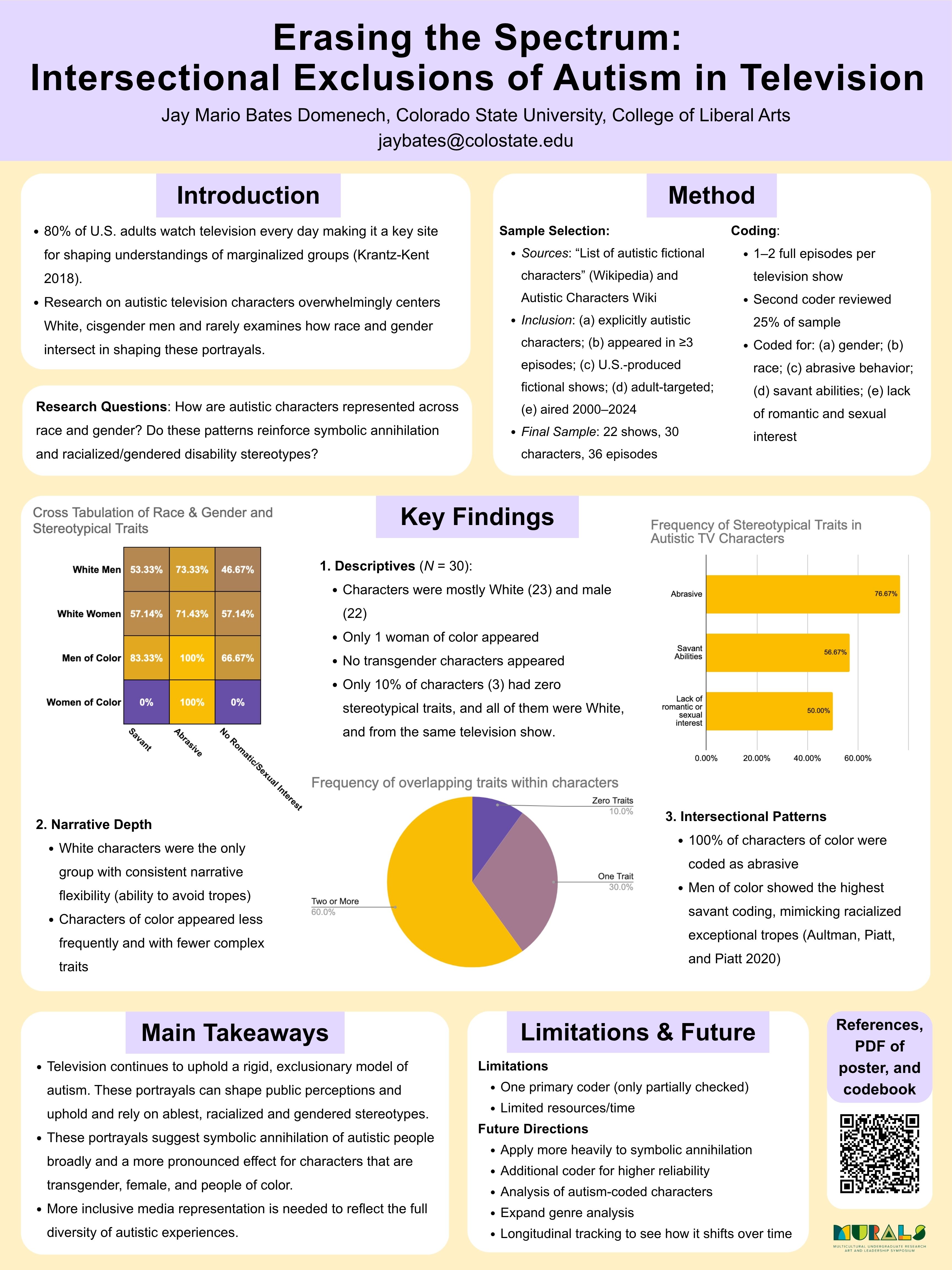
This study investigates representations of autism in television, focusing on how race and gender influence stereotypical patterns. Because most U.S. adults watch television every day, media remains a key site for shaping understandings of marginalized groups. Despite this, research on autistic television characters, overwhelmingly center White, cisgender men and rarely examines how race and gender intersect in shaping these representations. In this study, I examine explicitly labeled autistic characters who appeared in at least three episodes of scripted fictional television shows aimed at adult audiences, produced in the U.S., and that aired between 2000 and 2024. The analysis included 30 characters across 22 television shows. For each show, one to three episodes featuring the character were selected to ensure observational depth for systemic coding. Characters were coded for gender, race, and stereotypical traits: savant abilities, abrasive behavior, and lack of romantic or sexual interest. 25% of the sample was double-coded, and disagreements were discussed until consensus was reached. Results indicated that White (n=23) and male (n=22) characters dominated the sample, while men of color (n=6), women of color (n=1), and transgender characters (n=0) were nearly or completely absent. All characters of color were portrayed as abrasive, and 5 of 6 men of color were depicted as having savant abilities, making it the highest percent of any group. These findings suggest that U.S. television represents autism through a narrow lens that centers White, cisgender men while reinforcing racialized and gendered stereotypes.