
Using a Reduced Alphabet to Predict Localization of PrLD’s to Stress Granules
Category: Research Poster
Author(s): Levi Udell
Presenter(s): Levi Udell
Mentors(s): Eric Ross
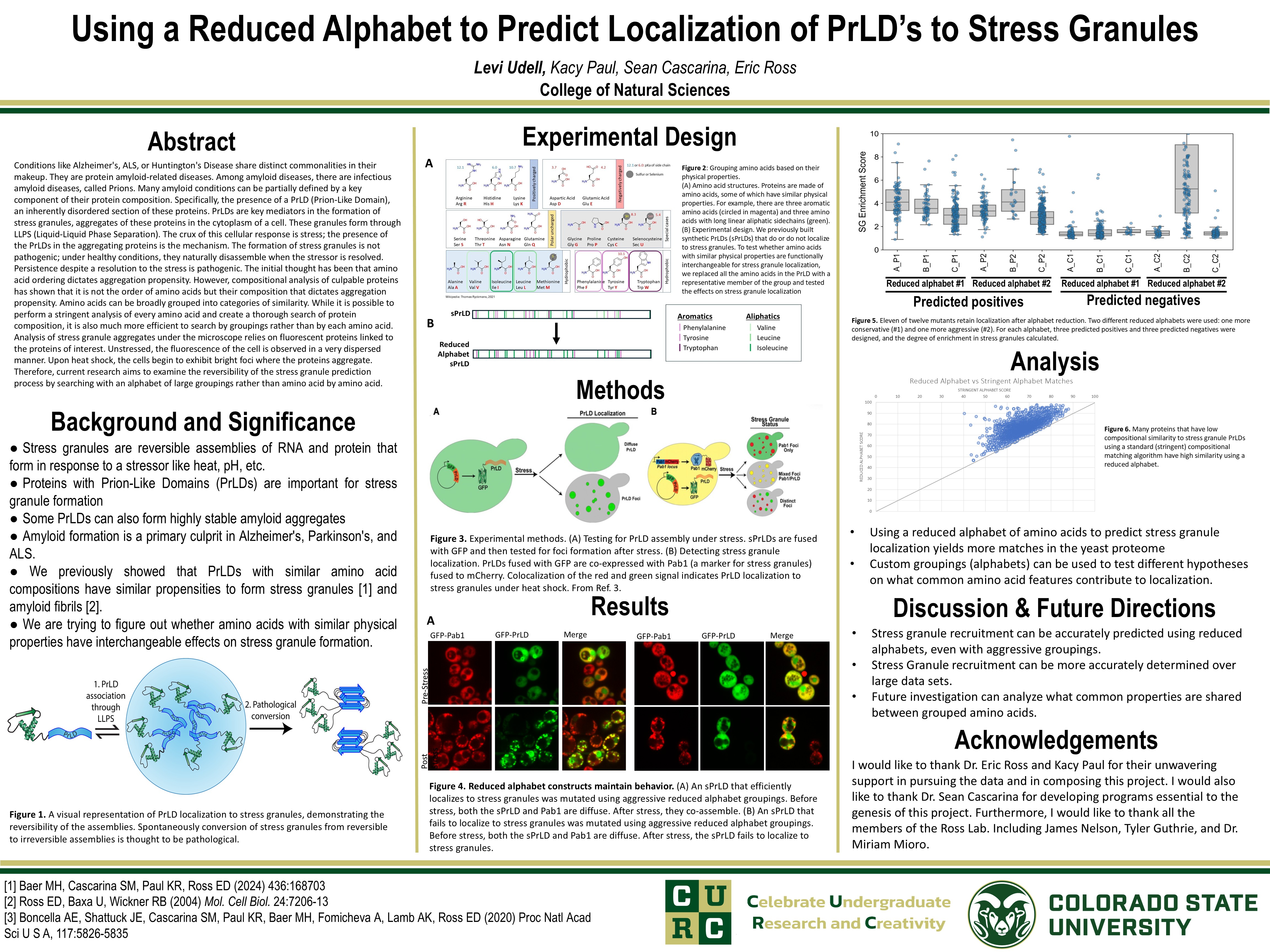
Conditions like Alzheimers Disese and ALS involve proteins that misfold and aggregate to form stable amyloid fibrils. Prions are a subset of amyloid diseases in which these aggregates are infectious. Many prion proteins contain regions with similar amino acid compositions; these prion domains (regions) are responsible for prion activity. Interestingly, many non-prion proteins contain Prion-Like Domains (PrLDs), which are disordered segments that resemble prions. PrLDs are key mediators in the formation of stress granules, which are assemblies that form in the cytoplasm of cells in response to stress. The formation of stress granules is not pathogenic; under healthy conditions, they naturally disassemble when the stressor is resolved. The persistence of stress granules after the resolution of the stress is pathogenic. Traditionally, the ordering of amino acids within a protein has been considered critical for determining protein activity. However, PrLD recruitment to stress granules is primarily dependent on amino acid composition rather than amino acid order. Searches for proteins that closely match the composition of all 20 amino acids of known stress granule-localized PrLDs have allowed the identification of new stress granule PrLDs. However, certain amino acids have similar physical properties, which suggests that matching the frequency of all twenty amino acids may be overfitting the data; it may be more efficient to group similar amino acids. Therefore, my research aims to test whether the stress granule predictioncan be improved by searching with an alphabet of large groupings rather than amino acid by amino acid.