
Subjective and Objective Social Status in Parents and Adolescents and How it Relates to Adolescents’ Emotion Regulation
Category: Research Poster
Author(s): Khu Hser, Shelley Haddock, Toni Zimmerman
Presenter(s): Khu Hser
Mentors(s): Reagan Miller-Chagnon
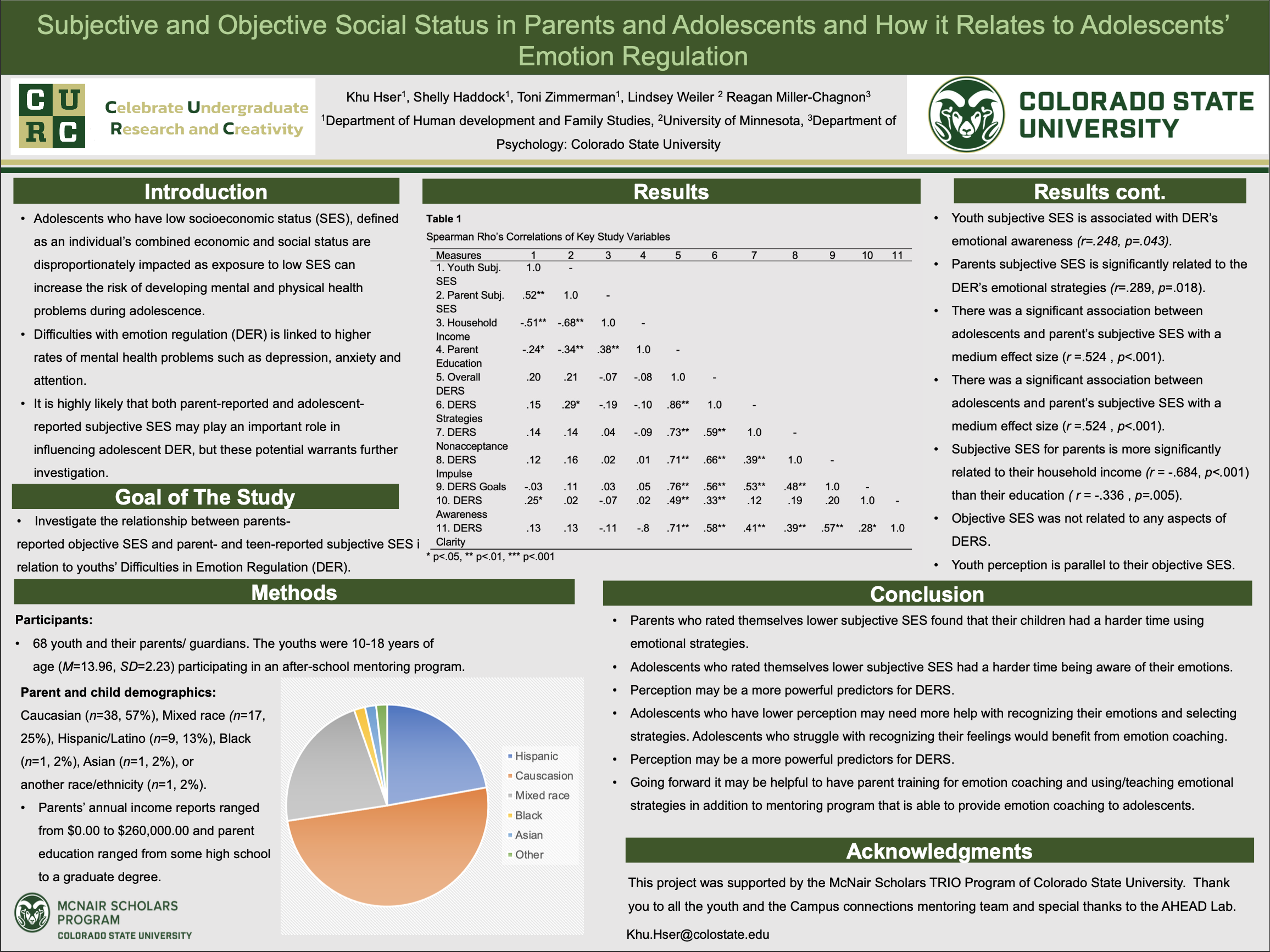
Adolescents with low socio-economic status (SES) are at high risk for developing mental health problems, in part, due to dysregulations in emotion regulation that can occur after chronic stress exposure. Despite a robust body of literature that demonstrates consistent associations between objective indicators of SES (e.g., income and parent educational attainment) and difficulties with emotion regulation (DERS), less is known about the impact of subjective indicators of SES, defined as how people view themselves and their resources in relation to others in their community and society. This study aims to investigate the relationship between parents-reported objective SES and parent- and teen-reported subjective SES in relation to youths' DERS. Participants were 68 youth (10-18 years-old; 57% boys/men; 57% non-Hispanic White) and their guardians who participated in a site-based mentoring program. Bivariate correlations revealed that adolescent and parent-reported subjective SES, but not parent-reported income and education were associated with DERS. More specifically, adolescents reported greater difficulties with emotional awareness when their parents also perceived themselves as having lower SES. Adolescents also reported greater difficulties using emotion regulation strategies when parents reported lower perceptions of SES. These results highlight that subjective indicators of SES may be more closely associated with adolescent difficulties with emotion regulation than more objective indicators. Within future research it will be important to investigate how DERS may meditate associations between subjective SES and adolescent mental health problems. It will also be helpful to investigate these relationships within a larger and more diverse sample.