
Livestock and Carnivore Coexistence in Larimer County
Category: Research Poster
Author(s): Lily Alderfer, Morgan Hertel, Jamie Raupp, Jenna Brager, Veronica Yovovich
Presenter(s): Lily Alderfer
Mentors(s): Morgan Hertel, Veronica Yovovich, Stephanie Moreira
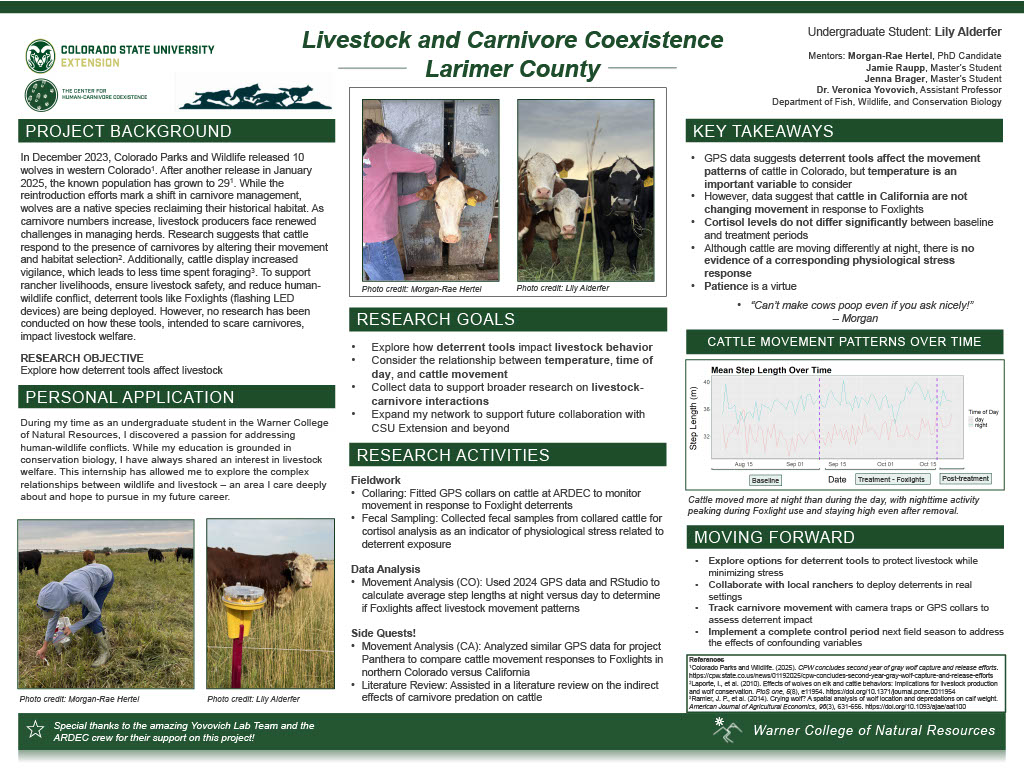
Large carnivore reintroduction in northern Colorado has renewed challenges for livestock producers, and deterrent tools are being deployed to reduce depredation and human–wildlife conflict. While visual deterrents such as flashing light devices are increasingly used to discourage carnivores, little is known about how these tools affect livestock behavior and welfare. Our project investigated the behavioral and physiological responses of cattle exposed to light-based deterrents, known as Foxlights, within a controlled research setting. Cattle were fitted with GPS collars to quantify movement patterns, with analyses focused on differences between daytime and nighttime activity as the deterrent tools only activate at night. Movement data were analyzed to assess changes in average step length associated with deterrent deployment. Fecal samples were collected from collared individuals to measure cortisol as an indicator of physiological stress. Results indicate that cattle exhibited increased nighttime movement during deterrent use, with elevated activity persisting briefly after removal. However, fecal cortisol concentrations did not differ significantly between baseline and treatment periods, suggesting that altered movement was not associated with increased physiological stress. Our findings emphasize the importance of considering livestock welfare alongside carnivore deterrence when developing conflict mitigation strategies and the need for further research in this area to support human-carnivore coexistence.