
Towards radium removal from saline wastewaters using MnO2-PAN resin
Category: Research Poster
Author(s): Samuel Helgerson, Benjamin Giese, Maelle Coupannec
Presenter(s): Samuel Helgerson
Mentors(s): Ralf Sudowe
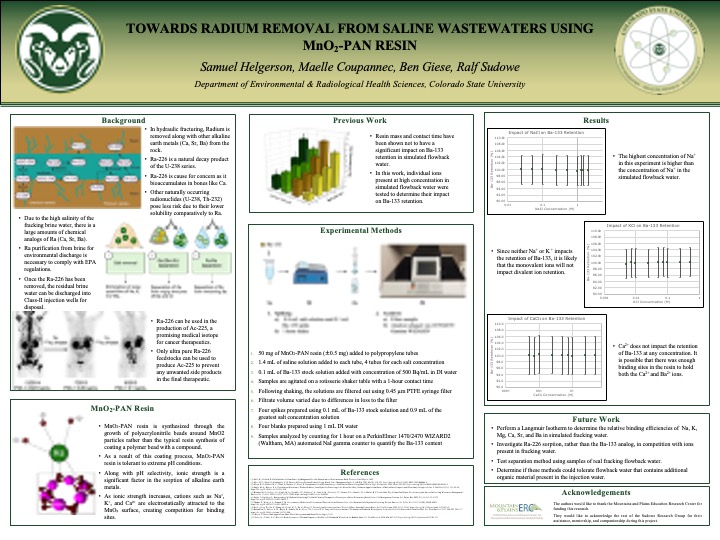
Hydraulic-fracturing flowback wastewaters contain high concentrations of dissolved salts and alkaline-earth metals, including radium from the decay of naturally occurring uranium. The radium in this waste stream presents a potential hazard to human and environmental health and is required to be removed until its concentration is below EPA release limits before discharge . One potential removal pathway is by using a chromatographic resin with a high affinity for radium. Manganese dioxide–PAN (MnO₂-PAN) resin is widely used for radium sorption due to the strong affinity of manganese oxides for alkaline-earth metals. Radium and barium sorption onto MnO₂-PAN occurs primarily through precipitation and electrostatic interactions with macroporous resin substrate. These interactions are strongly influenced by pH and ionic strength. Optimal uptake occurs between pH 4 and 8. High ionic strength solutions, however, introduce significant competition from Na⁺, K⁺, Ca²⁺, and other cations. In this research, the radioactive isotope Ba-133 is used as an analogue of Ra-226 due to the high cost and low availability of Ra-226 tracers. While MnO₂-PAN can extract Ba-133 from water, its performance under highly saline conditions,₂-PAN can extract Ba-133 from water, its performance under highly saline conditions, which include hydraulic-fracturing flowback, batch experiments were conducted using simulated flowback water containing Ba-133. Resin mass and contact time were varied, and Ba-133 uptake was quantified by gamma spectrometry. Results showed that sorption was more dependent on resin quantity than contact duration, with a maximum recovery of roughly 8% under highly saline conditions. These findings suggest significant sorption inhibition in complex brines. Current research will investigate the effects of NaCl, KCl, and CaCl₂ concentrations and determine the resin’s maximum Ba adsorption capacity to better define the conditions under which MnO₂-PAN is effective for radium absorption.