
Investigation of MnO2 coated detonation nanodiamonds for preconcentration of alkaline earth elements from aqueous systems
Category: Research Poster
Author(s): Keera Payne, Ralf Sudowe, Benjamin Giese
Presenter(s): Keera Payne
Mentors(s): Ralf Sudowe
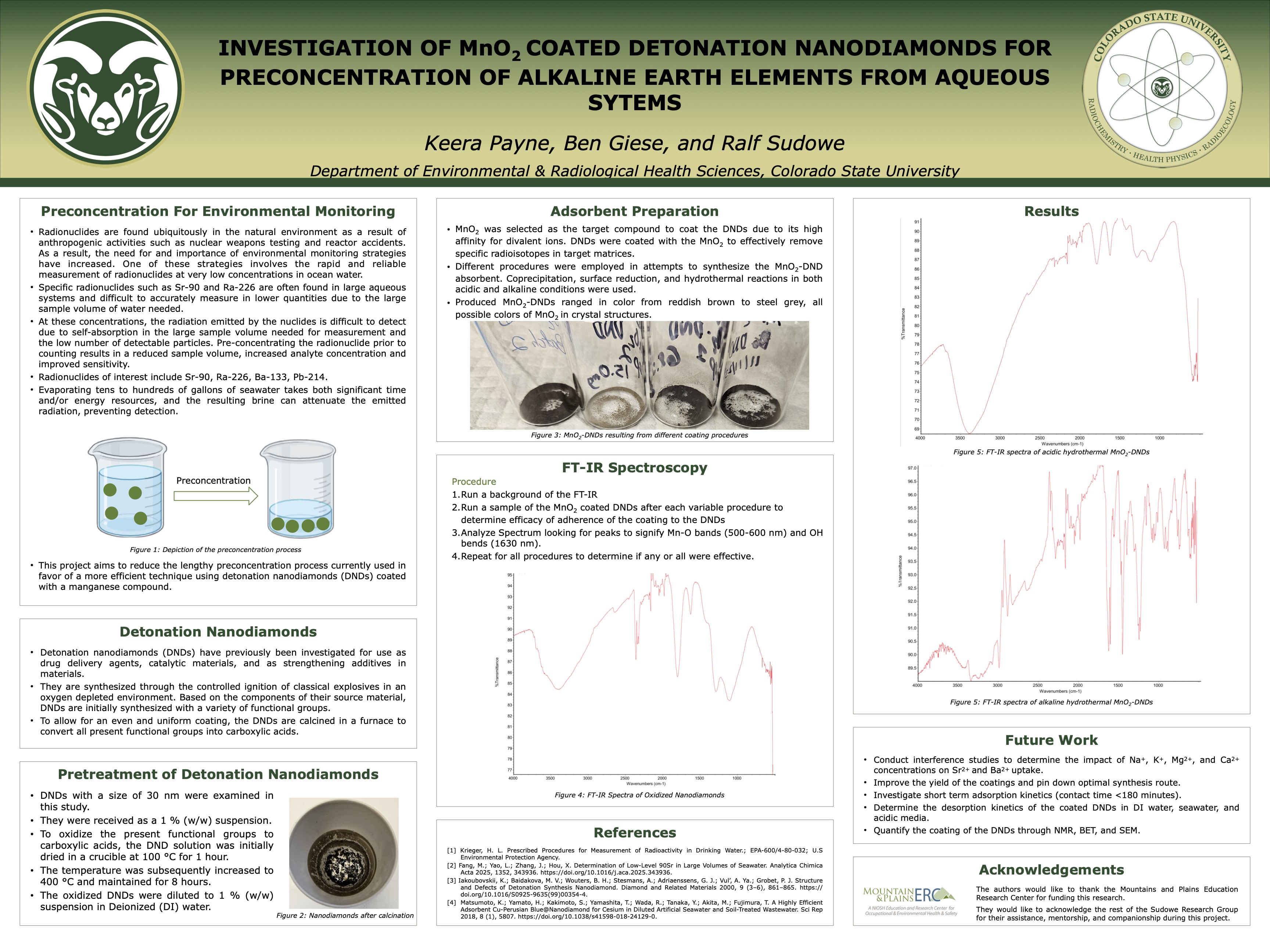
Naturally occurring radionuclides are found ubiquitously in the natural environment as a result of various anthropogenic activities such as nuclear weapons testing and reactor accidents such as Ra-226 and Ra-228 resulting from the decay of U-238 and Th-232. Specific radionuclides, such as Sr-90 and Ra-226, are often found in large aqueous systems and are difficult to accurately measure in lower quantities due to the large sample volume of water needed. Current sampling technology involves collecting large sample volumes of water and by means of evaporation or precipitation, reducing the volume, and measuring the radionuclides present. This project aims to reduce the lengthy processes currently used in favor of a more efficient collection and measuring system. To do so, detonation nanodiamonds (DNDs) were coated with a manganese compound that was chosen based on its affinity for divalent ions. In this experiment the nanodiamonds were baked to isolate carboxylate compounds on the surface. The nanodiamonds were then coated with manganese to achieve a coating that would effectively remove specific radioisotopes in target matrices. FTIR spectroscopy was used to verify the manganese species on the nanodiamonds and a series of batch acid tests were conducted to verify the strength of the coating. Interference studies were completed to determine the impact of Na+, K+, Mg2+, and Ca2+ concentrations on Sr2+ and Ba2+ uptake.