
Blooming Threats: Assessment of Harmful Algal Blooms in Urban Ponds of Fort Collins, Colorado
Category: Community Engagement Poster
Author(s): Tina Blugel, Savannah Crisler
Presenter(s): Tina Blugel, Savannah Crisler
Mentors(s): Olivia Arnold
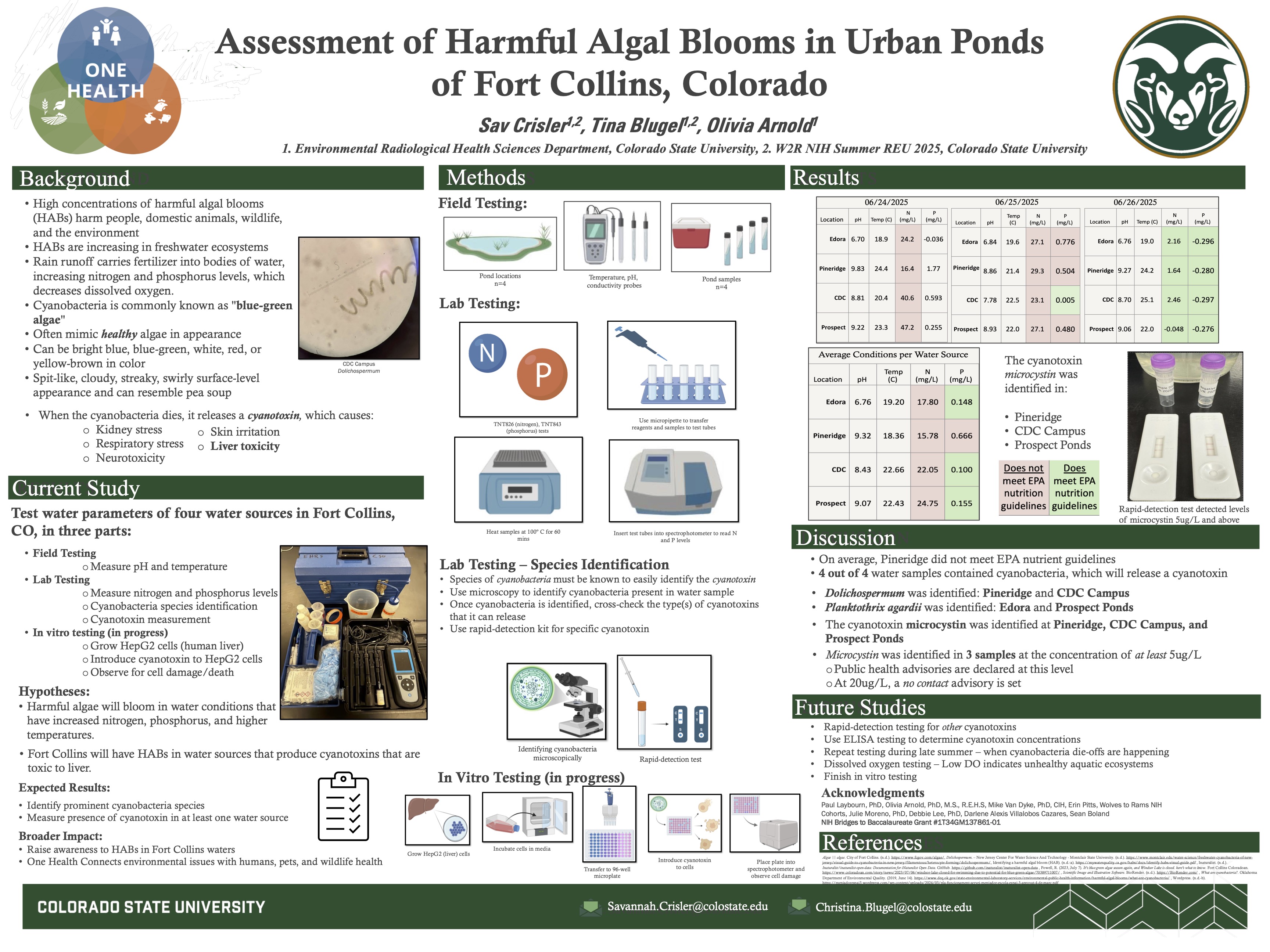
Harmful algal blooms (HABs) are an increasing global concern due to their potential to produce toxins that threaten human, animal, and environmental health. This study evaluated four urban ponds in Fort Collins, Colorado (Pine Ridge, Prospect Ponds, Edora Lake, and the CDC Campus pond) to investigate relationships among opportunistic cyanobacteria, nutrient enrichment, and toxin presence. Field measurements of temperature and pH were collected, and laboratory analyses were conducted to determine total nitrogen and total phosphorus concentrations. Microscopic evaluation of water samples was used to identify cyanobacterial taxa and assess morphology indicative of potential toxin production. Rapid immunoassay test kits were employed to detect the presence of microcystin. Dolichospermum spp. were identified in Pine Ridge and CDC Campus samples, while Planktothrix agardhii was observed at Prospect Ponds and Edora Lake. Microcystin was detected in three of the four ponds, with concentrations ranging from 5 µg/L to 19 µg/L. These results exceed the U.S. Environmental Protection Agency’s recreational water quality guideline of 5 µg/L for microcystin, indicating potential public health risks associated with recreational exposure. The findings suggest that eutrophication and nutrient enrichment may promote HAB occurrence in Fort Collins’ urban waters. Future directions include expanding the sample size, conducting ELISA assays to quantify specific cyanotoxin concentrations, performing seasonal resampling, and implementing in vitro cytotoxicity assays to evaluate health impacts. Overall, this project contributes to understanding local HAB dynamics and supports ongoing efforts to protect public and environmental health in northern Colorado.