
The Structure of Global Migration & Citizens Attitudes Toward Immigration
Category: Research Poster
Author(s): Pi Blehm
Presenter(s): Pi Blehm
Mentors(s): Anthony Roberts
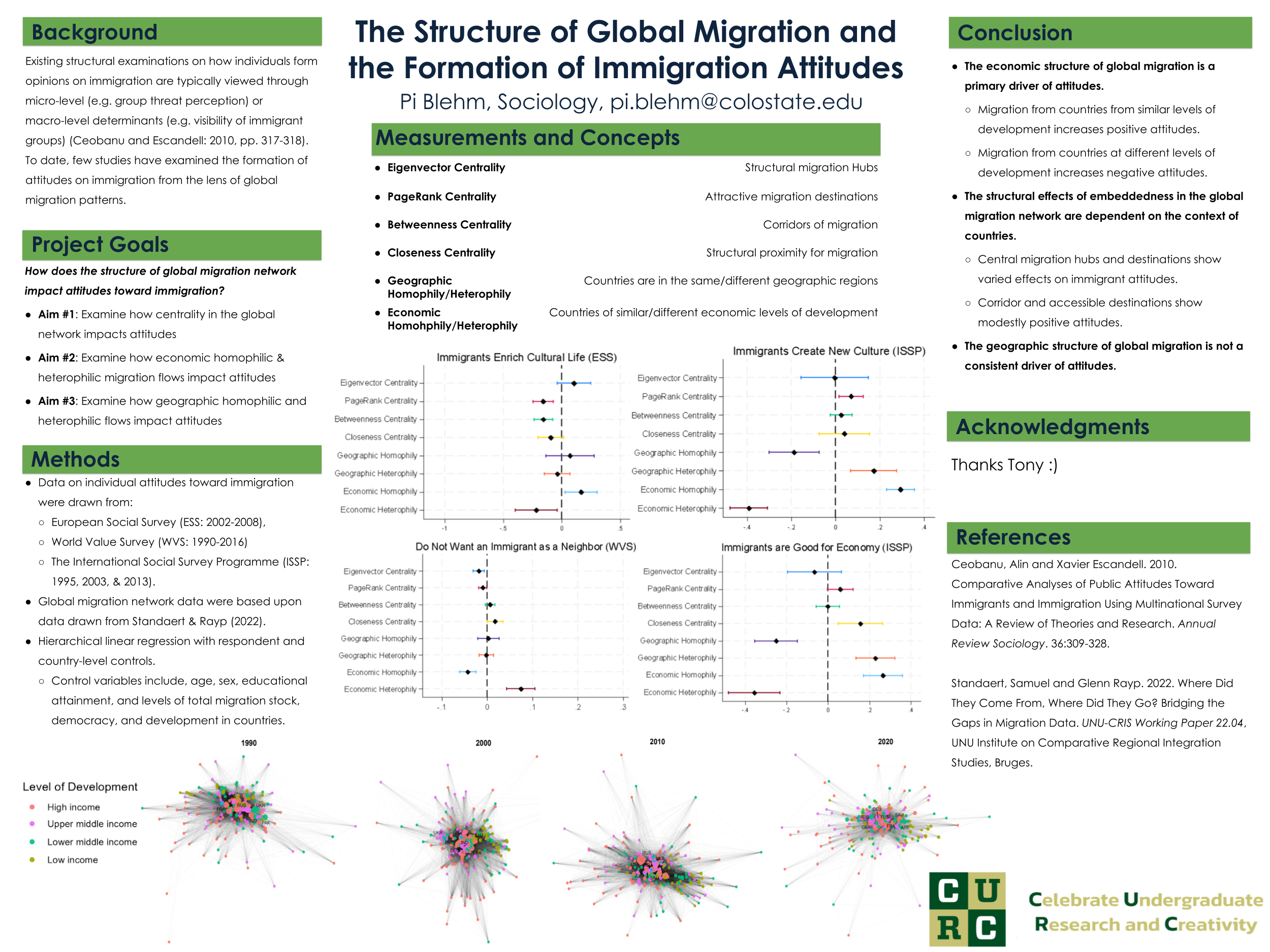
Despite extensive comparative research on immigration attitudes, few studies examine how the structure of global migration patterns shape public opinion about immigration. This study addresses the gap in the literature by analyzing how country-level embeddedness in the global migration network influences individual evaluations of immigration across 80 countries in the twenty-first century. Drawing from longitudinal data from the European Social Survey, World Values Survey, and International Social Survey Programme, we estimate models to test the effect of a country’s centrality, economic homophily and heterophily, and geographic homophily and heterophily on that country’s opinion of migrants. We find that respondents in more central countries express stronger preferences for restrictive immigration policy, encourage greater social distance from immigrants, and have more negative beliefs about immigration’s consequences. In contrast, migration flows connecting economically and geographically similar countries are associated with more favorable views. Our findings show that public opinion about immigration is reflective of a countries’ position within the global migration system, underscoring the importance of macrostructural migration patterns in shaping contemporary immigration attitudes.