
Complementation of CRISPR-Cas9 Edited Phage P68 Knockouts
Category: Research Poster
Author(s): Aubrey Kahler
Presenter(s): Aubrey Kahler
Mentors(s): Claudia Gentry-Weeks
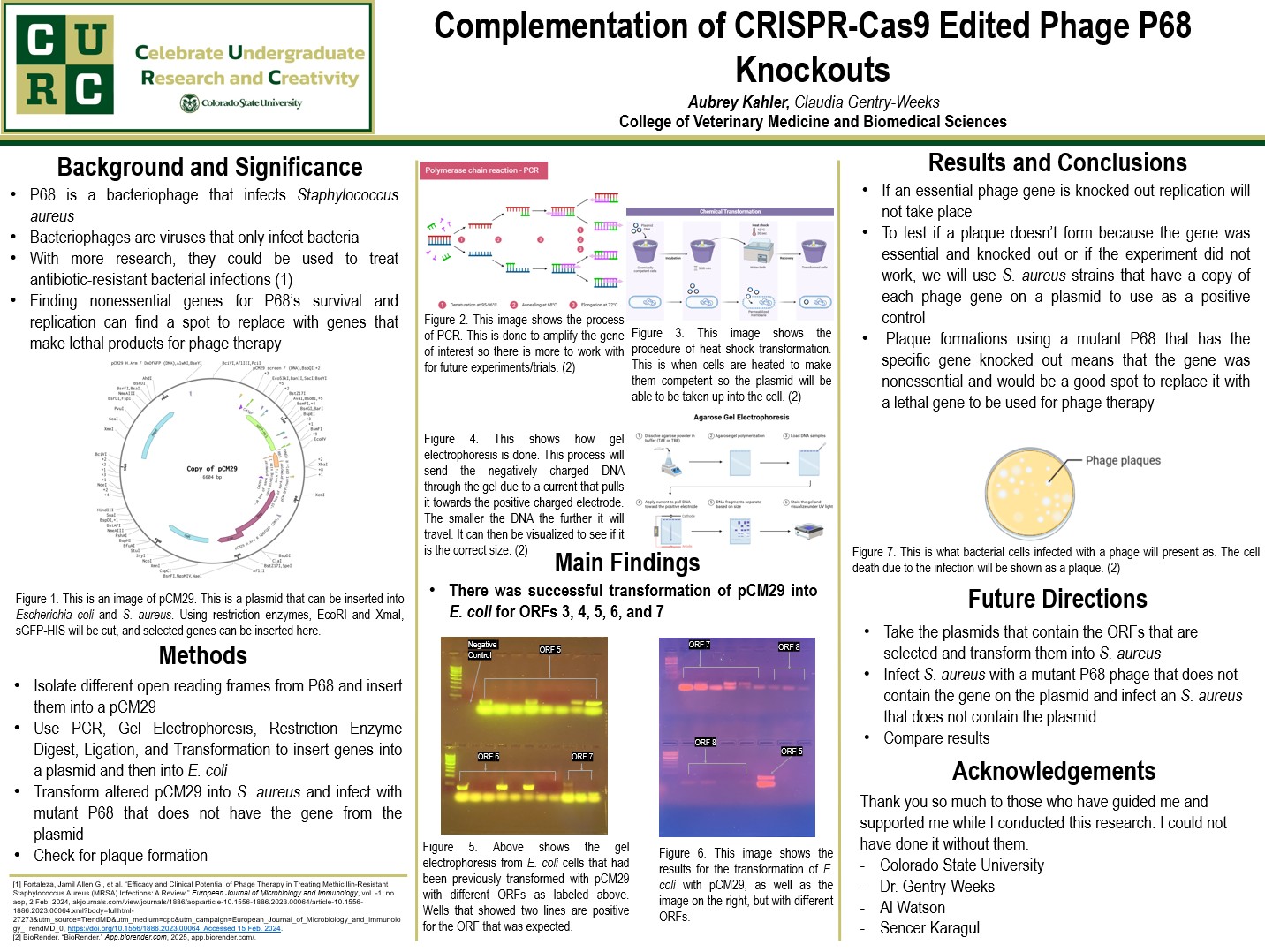
Bacteriophages (phages) are viruses that only infect and kill bacteria. They have been used to treat antibiotic-resistant bacterial infections. Our laboratory has been studying phage P68 of Staphylococcus aureus as a possible phage for phage therapy. We are making knockouts in each phage gene to determine which genes are needed and which are not for the phage to replicate and make phage particles. Once nonessential genes are identified, they can be replaced with genes that make lethal products, increasing the likelihood of success for phage therapy. If we knock out essential phage genes and introduce these mutant phages into S. aureus, replication of these phages will not occur, and no phage will be recovered. If phages aren’t recovered, it is impossible to know whether the experiment didn’t work or if an essential phage gene was knocked out. To solve this problem, my research project is to make S. aureus strains that contain a copy of each intact working phage gene on a plasmid to use as a positive control. Phage mutants that have an essential gene knocked out will not be able to replicate in S. aureus. However, if the essential gene is supplied in S. aureus on a plasmid, this will allow the mutated phage to replicate. Phage mutants containing a nonessential gene knocked out will grow in S. aureus, either with or without the gene supplied on a plasmid. Using this method, we can identify nonessential phage genes that can be replaced in S. aureus phage P68.