
Archiving Our Stories: The Art of Ranching and Community Partners in Routt County
Category: Community Engagement Poster
Author(s): Avery Anderson
Presenter(s): Avery Anderson
Mentors(s): Leisl Carr Childers
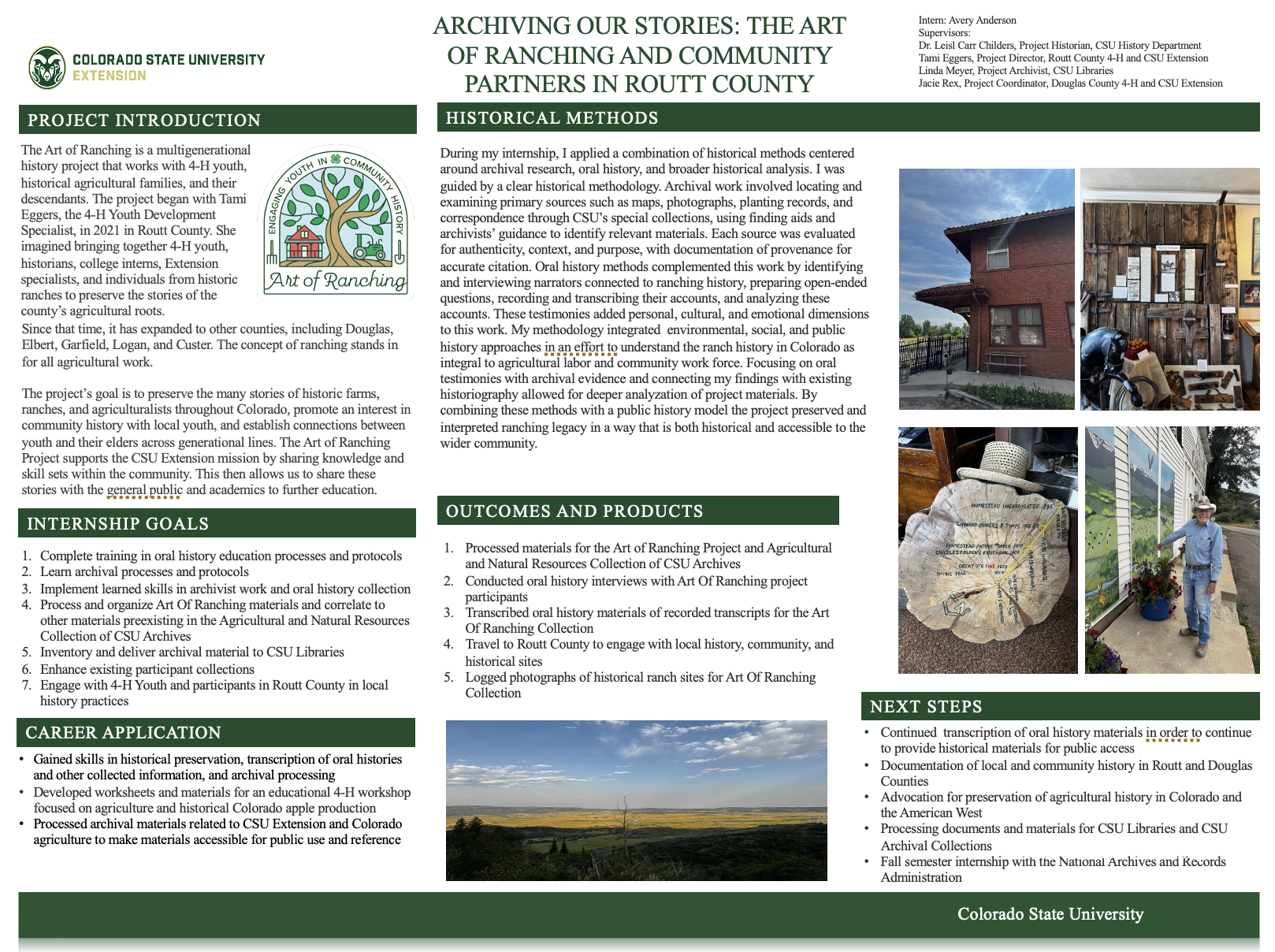
This project documents and interprets Colorado’s agricultural and ranching heritage through the public history initiative The Art of Ranching, a collaboration among 4-H youth, historical agricultural families, CSU Extension, and Colorado State University Libraries. The project originates in Routt County and began in 2021. Since then, the project has expanded to multiple counties across Colorado and uses ranching as a lens to understand agricultural labor, land use, and community identity. During my internship, I utilized a mixed historical methodology through participating in archival research, oral history interviews, and environmental and social history. My archival work involved processing, organizing, and evaluating materials including photographs, maps, planting records, and correspondence within the Agricultural and Natural Resources Collection at CSU Libraries. Oral history practices complemented this work through the identification, interviewing, recording, and transcription of project participants. I was able to capture personal narratives that situate agricultural practices within real lived experience. This work allowed for a deeper analysis of how ranching traditions shape intergenerational knowledge, community memory, and regional identity in Colorado. My project outcomes included the processing of archival materials, transcription of oral histories, photographic documentation of historic ranch sites, and direct engagement with local communities in Routt County. The project advances public history by preserving agricultural narratives and fostering youth and community participation. Future work will continue transcription efforts, expand documentation, and support long-term access to agricultural history through CSU archival collections and public education.