
Brook Trout Population Connectivity and Gene Flow Post Wildfire
Category: Research Poster
Author(s): Audre Young-huggins
Presenter(s): Audre Young-huggins
Mentors(s): Yoichiro Kanno
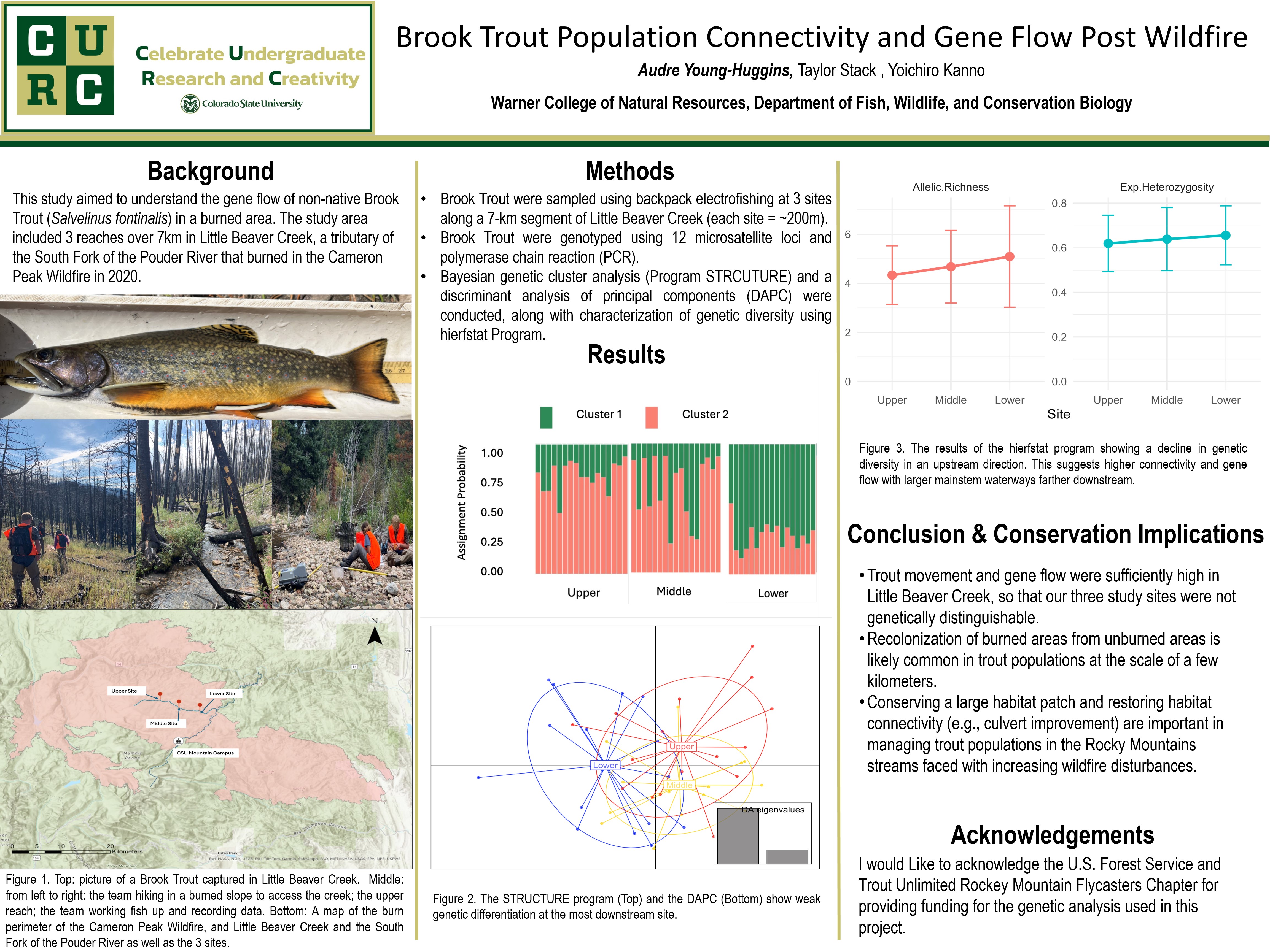
This study explores Brook Trout (Salvelinus fontinalis) genetic flow in Little Beaver Creek, a tributary of the South Fork of the Pouder River that sections of were burnt in the Cameron Peak Wildfire in 2020. We were interested in understanding how the wildfire disturbance would impact the gene flow of Brook Trout especially with the increase of wildfire severity in the American West. Anal fin clips from Brook Trout were collected at 3 sampling sites along a 7-kilometer section of Little Beaver Creek. To investigate genetic structure across our sampling sites, Brook Trout were genotyped at 12 neutral microsatellite loci using polymerase chain reaction (PCR) and capillary electrophoresis. Using STRUCTURE and R Studio we analyzed how the population was structured between the three sites to investigate whether the sites experienced enough gene-flow to allow for recolonization after the wildfire. At the 7-kilometer spatial scale that there was enough connectivity for the population to recolonize even after wildfire may have eradicated a local population in the areas it burned. A slight genetic signature at the uppermost sight was detected through the STRUCTURE and DAPC analyses. The slight increased amount in genetic diversity at the lower sites indicates that more migrants are received because they are closer to tributaries, allowing for more genetic diversity. Lower diversity in upstream areas may indicate that they are harder to recolonize making them more vulnerable to disturbances, whereas locations downstream may be more easily recolonized by tributaries making them more resilient.