
Electro-Enhanced Anaerobic Digestion to Increase Production of Volatile Fatty Acids
Category: Research Poster
Author(s): Polina Zaytseva
Presenter(s): Polina Zaytseva
Mentors(s): Danielle Bartholet, Kenneth Reardon
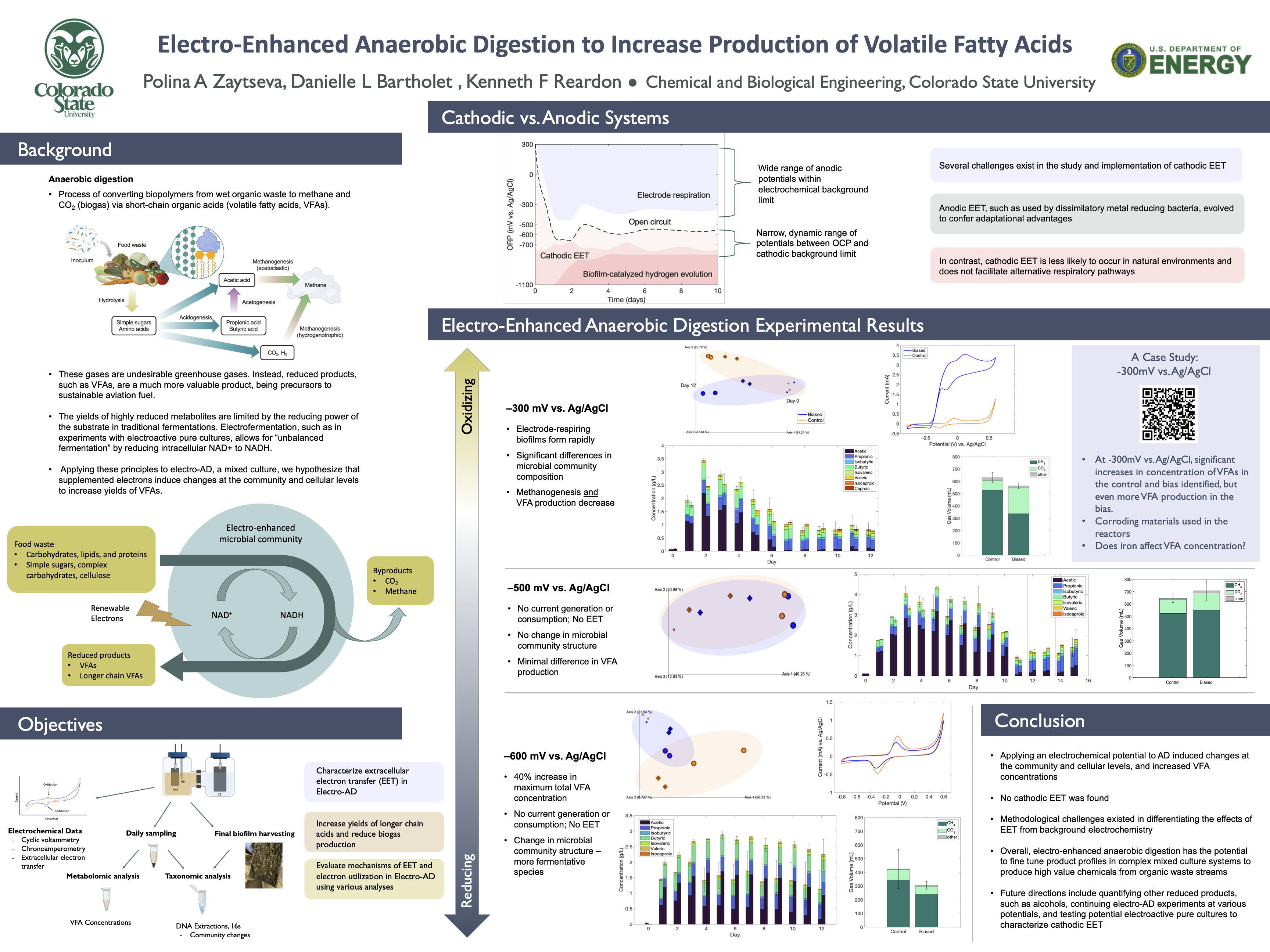
Anaerobic digestion (AD) is a process where organic materials are broken down into carbon dioxide and methane. However, these gases are economically unviable as fuels. In contrast, volatile fatty acids (VFAs), intermediates in AD, show much more promise as they are precursors to sustainable aviation fuels. Since longer-chain VFAs are more desirable, shifting acid profiles towards these longer-chain VFAs is also of interest. In pure cultures, electro-fermentation has been explored as a strategy to shift product profiles toward more reduced products by overcoming intracellular redox limitations. Applying this concept to mixed culture processes similarly influences processes on cellular and community levels by affecting microbial community structure. Electro-enhanced AD has shown that applied potentials can induce changes in microbial community composition, redox behavior, and product profiles. Methodological challenges exist in differentiating the effects of direct electron transfer (DET) from background electrochemistry. Recognizing these challenges led us to investigate common pitfalls that lead to misinterpretations. For instance, the use of certain electrode materials can lead to anaerobic corrosion, which potentially influences metabolic processes through the release of iron and hydrogen evolution. Overall, electro-AD affects microbial community structure and product profiles. Electro-enhanced experiments were performed at applied potentials between –300 and –750 mV vs. Ag/AgCl. Metabolic, electrochemical, and taxonomic analyses studied the effects of DET and redox control on AD. Results indicated maximal total VFA productions at an applied potential of –600 mV vs. Ag/AgCl and a significant difference in microbial community structures between the control and biased reactors.