
Progress Towards Genetically Engineered Cell Cycle Arrest in Human Cells
Category: Research Poster
Author(s): Hannah Reitman, Colton Karns, Alisa Shaw, Grant Schauer
Presenter(s): Hannah Reitman
Mentors(s): Grant Schauer
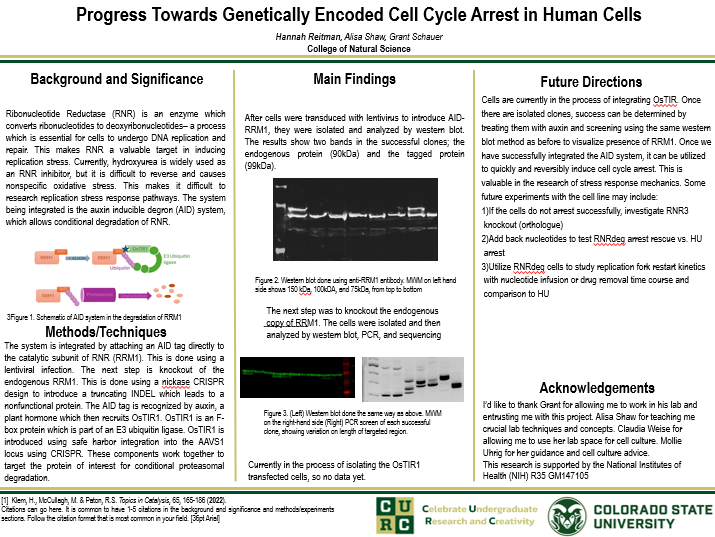
The ability to temporarily induce replication stress within cells is valuable in the research of replication machinery and stress response pathways. To induce replication stress, researchers often target ribonucleotide reductase (RNR), an enzyme which is responsible for the conversion of ribonucleotides into deoxyribonucleotides, and which is essential to the progression of DNA replication. Currently, Hydroxyurea is widely used to inhibit RNR, but cells are burdened by oxidative stress caused by the drug, which causes not only specific inhibition of the replication machinery, but also nonspecific stress in cells that is difficult to reverse and which can be cytotoxic. This confounds our ongoing studies of the pathways responsible for replication stress tolerance. Our system being implemented utilizes auxin—a plant hormone which binds to and activates an E3 ubiquitin ligase which then targets the protein of interest for proteasomal degradation. This system allows conditional degradation of ribonucleotide reductase, ultimately preventing the cells from proceeding through DNA replication.