
Four inexpensive, accessible smartphone-based neuromuscular physiology experiments for the teaching laboratory
Category: Research Poster
Author(s): Shea Kramer
Presenter(s): Shea Kramer
Mentors(s): Brian Tracy
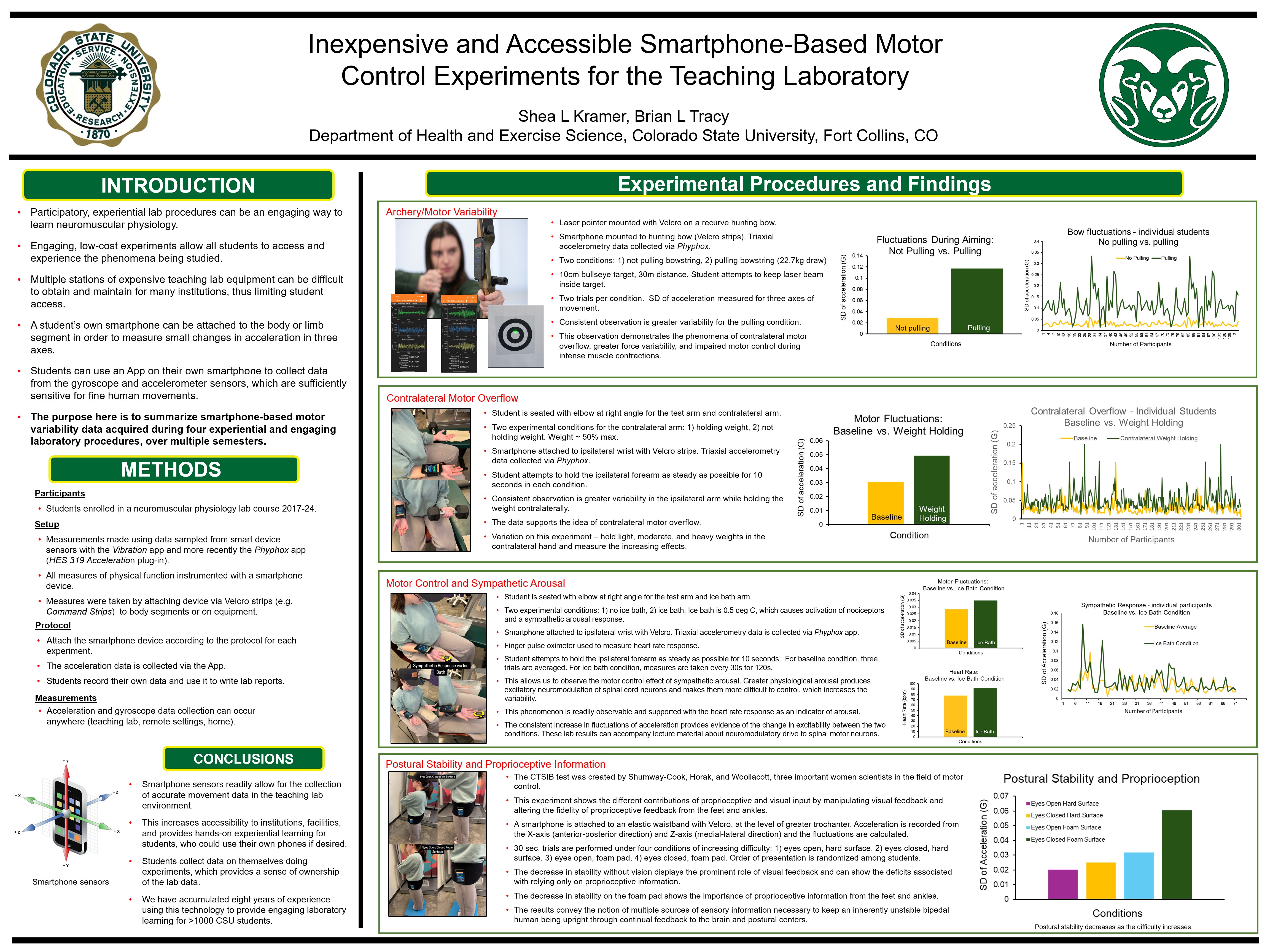
An experiential teaching lab environment engages and motivates students with learning materials. Here we describe four very inexpensive and easily accessible smartphone-based motor control/variability labs. Sensors in common smartphones are used to measure acceleration fluctuations in limb and body movement. Physiological arousal – An ice bath is used to induce a sympathetic response. Heart rate (pulse oximeter) and fluctuations in forearm acceleration (smartphone) are measured in the test arm. More motor variability and increased heart rate are observed during the ice condition. Archery/contralateral overflow – A laser pointer mounted on a hunting bow is aimed at a 10cm target from a 30m distance. A smartphone is used to measure tri-axial accelerometry changes from the bow. Two conditions are compared: 1) pull the bowstring (23kg), 2) no pull. The change in motor variability during a more intense task is observed. Contralateral motor overflow – The position of a test arm is controlled under two conditions: contralateral arm held in position with/without a weight (50% max). Triaxial fluctuations of the test arm are measured with a smartphone. Conditions are compared to reveal contralateral overflow of motor excitation. Balance/proprioception – Postural stability (ant/post, med/lat) is measured with a smartphone in four conditions: hard surface eyes open/closed, soft surface eyes open/closed. Manipulation of sensory information reveals the importance of the different inputs.