
Chronological Age, Sex, and Muscle Fiber Type as Determinants of Extracellular Vesicle Secretion and Diameter in Mice
Category: Research Poster
Author(s): Ellie Shyu, Darby Easterday, Devin Wahl, Shelby Osburn, Thomas LaRocca
Presenter(s): Ellie Shyu
Mentors(s): Daniel Lark
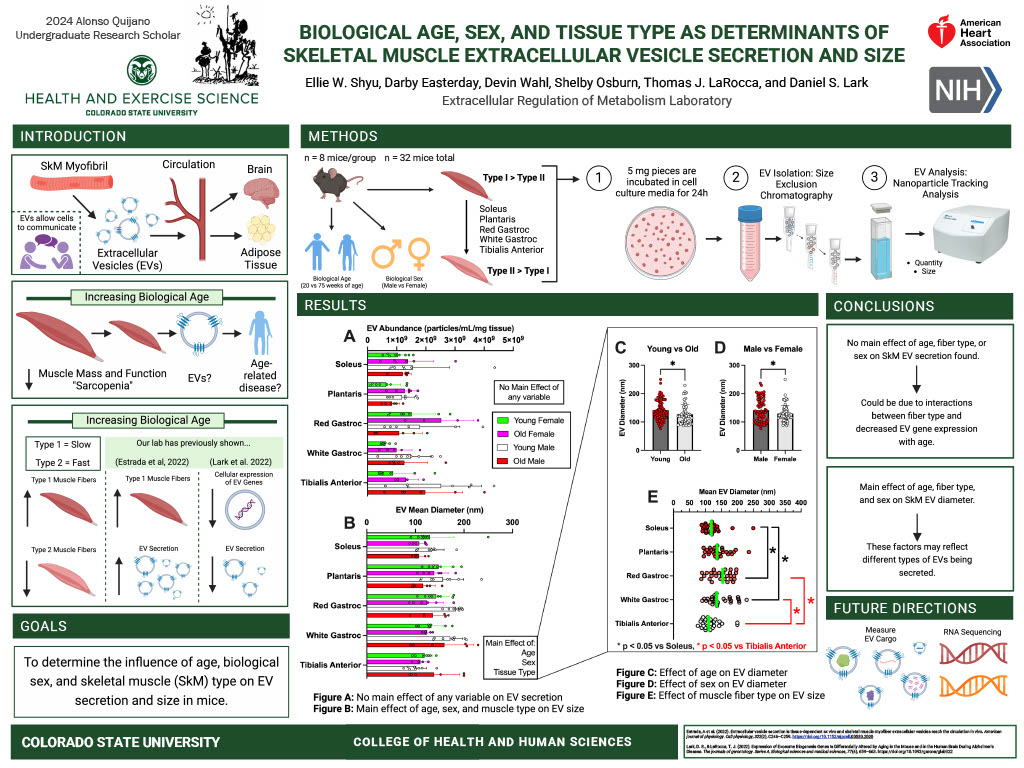
Background: Extracellular vesicles (EVs) enable cellular communication and are secreted by all organs of the body, including skeletal muscle (SkM). Aging is associated with changes in EV characteristics, but its impacts on EV secretion and diameter are poorly defined. Methods: This study analyzed the effects of biological age, sex, and SkM type on EV secretion and diameter. SkM was collected after euthanasia, cut into 5 mg pieces, and incubated in cell culture media for 24 hours. We isolated EVs from conditioned media and quantified them. A 3-way ANOVA was performed with Tukey multiple comparisons testing. Results: No significant main effect or interactions was observed for age, sex, or tissue type, but there was a trend (p = 0.10) for a sex x age interaction. There was a main effect of tissue, sex and age on mean EV diameter but no significant interactions between variables. Multiple comparisons analysis did not clearly explain differences across variables. There was a main effect of sex and a significant tissue x sex x age interaction on modal EV diameter. No individual differences were observed in multiple comparisons testing for modal EV diameter. Conclusion: This data suggests that aging may not decrease SkM EV secretion, and that sex may be a relevant variable in age-dependent changes to secretion. EV cargo is another major factor for EV function, so our ongoing work examines differences in EV composition. Differences in EV cargo may be indicators of diseases.