
Tauopathy Distribution in Companion Animals and the Search for an AD Model
Category: Research Poster
Author(s): Aidan Flanagan
Presenter(s): Aidan Flanagan
Mentors(s): Abdullatif Alsulami, Julie Moreno
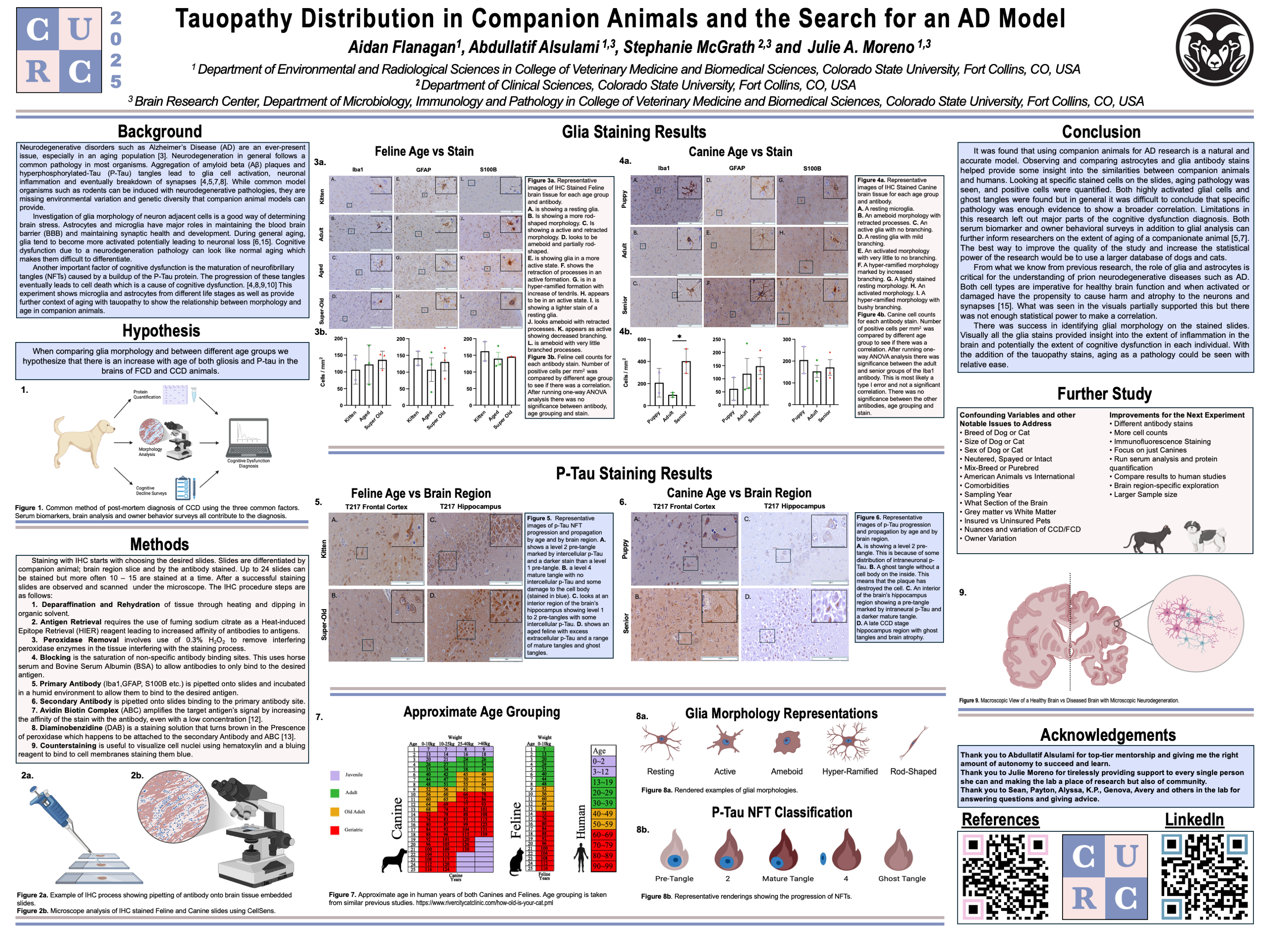
Neurodegenerative disorders such as Alzheimer’s Disease (AD) are an ever-present issue, especially in an aging population. Neurodegeneration in general follows a common pathology in most organisms. Aggregation of amyloid beta (Aβ) plaques and hyperphosphorylated-Tau (P-tau) tangles lead to glia cell activation, neuronal inflammation and eventually breakdown of synapses. While common model organisms such as rodents can be induced with neurodegenerative pathologies, they are missing environmental variation and genetic diversity. When looking for an AD model organism, differences in environmental factors, genetics and disease pathology are all considered. This can be the advantage of having a companion animal model. They live with us, are exposed to the same environmental factors and have considerable genetic diversity. Since mild to severe age-related cognitive dysfunction is found in both felines and canines (FCD and CCD respectively), companion animals are natural and most accurate models for AD research. We hypothesize there is an increase with age in both gliosis and P-tau in the frontal cortices of brains from FCD and CCD animals. To determine this correlation, we utilized immunohistochemistry (IHC) staining of glial marker Iba1, and astrocyte markers S100β and GFAP. Ten of each companion animal were sampled and P-tau pathology was investigated by positive cell counting and glial morphology analysis. Unlike what was expected, glial activation and P-tau accumulation does not always correlate with age. It was concluded that larger sample sizes and different antibodies could determine other sites of gliosis and P-tau pathology to find a stronger correlation.