
Effects of fatigue and exercise intensity on exercise enjoyment during an outpatient cancer rehabilitation program
Category: Research Poster
Author(s): Jessica Franson, Emma Gomes
Presenter(s): Jessica Franson
Mentors(s): Heather Leach
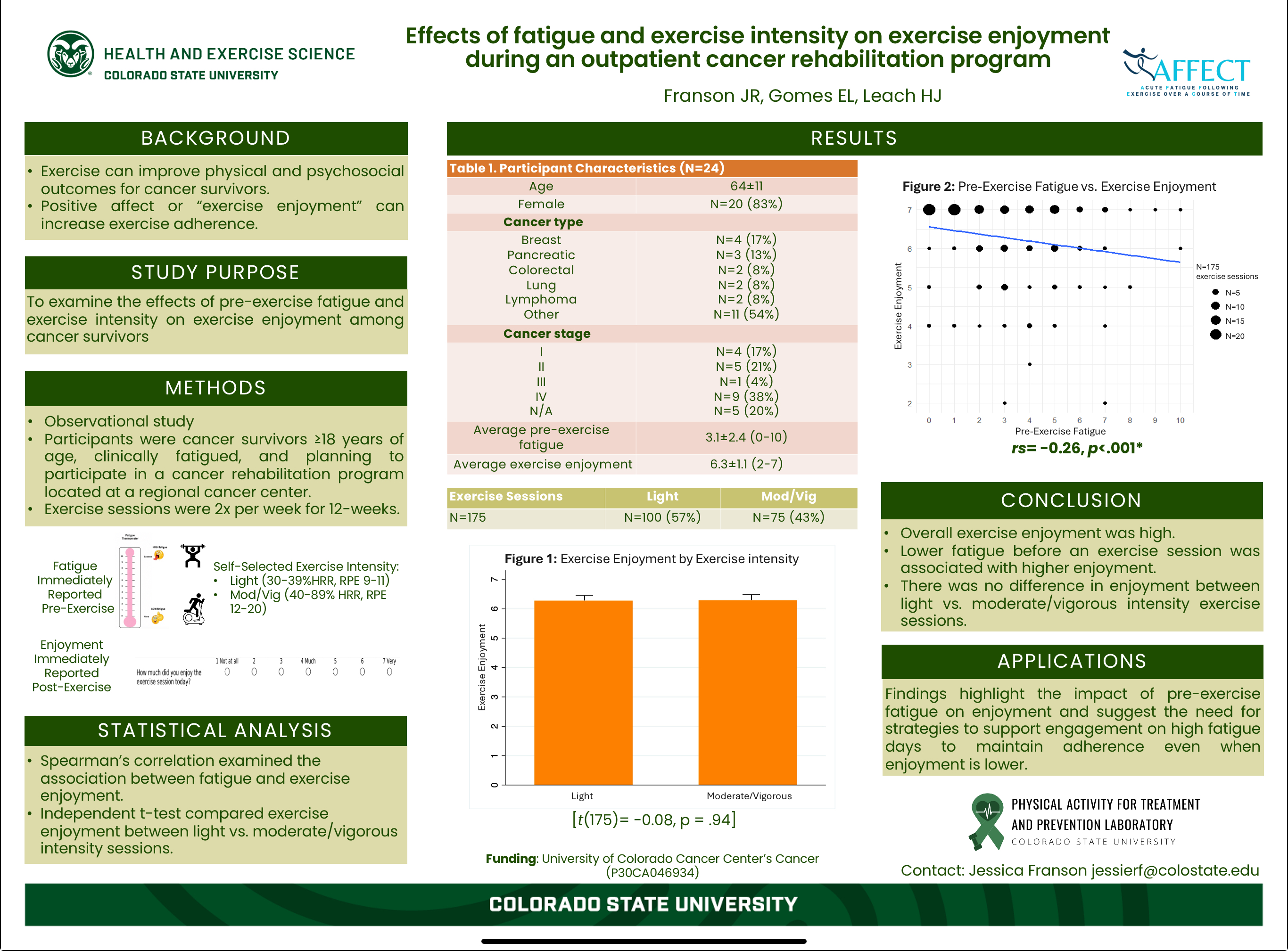
Purpose: Exercise can improve physical and psychosocial outcomes for cancer survivors, and positive affect or “exercise enjoyment” can increase exercise adherence. This study examined the effect of fatigue and exercise intensity on exercise enjoyment. Methods: Observational study of participants enrolled in a 12-week outpatient cancer rehabilitation program, with exercise sessions (ES) twice per week. Exercise enjoyment was measured after each ES (1= not at all – 7= very much). Fatigue was measured before each ES (0=no fatigue – 10=worst fatigue). Exercise intensity was self-selected, and ES were categorized as low (30-39% HRR & RPE range 9-11) or moderate to high (40-89% HRR & RPE range 12-20). A spearman’s correlation examined the association between fatigue and enjoyment, and an independent t-test compared enjoyment between low vs. moderate-high intensity ES. Results: Participants (N=24) were M=64±11 years old, 83% female, represented 14 different cancer types, and completed N=181 ES. Average exercise enjoyment was 6.2±1.1 (range 2-7). Average fatigue was 3.1±2.4 (range 0-10). Over half (N=102, 57%) of ES were low intensity. Fatigue was inversely associated with enjoyment (rs= -0.26, p<.001). There was no difference in enjoyment between light (M=6.3±1.1) and moderate-high (M=6.3±=1.0) intensity ES [t(175)= -0.08, p = .94]. Conclusion: Overall, exercise enjoyment was high, but worse fatigue before an ES was associated with lower enjoyment. There was no difference in enjoyment between low vs. moderate-high ES. These findings highlight the impact of fatigue on exercise experiences and suggest the need for strategies to support engagement on high-fatigue days to maintain adherence even when enjoyment is lower.