
Intro to Modular Forms
Category: Oral Presentation
Author(s): Andrea Bernardy
Presenter(s): Andrea Bernardy
Mentors(s): Sandra Dileep Nair
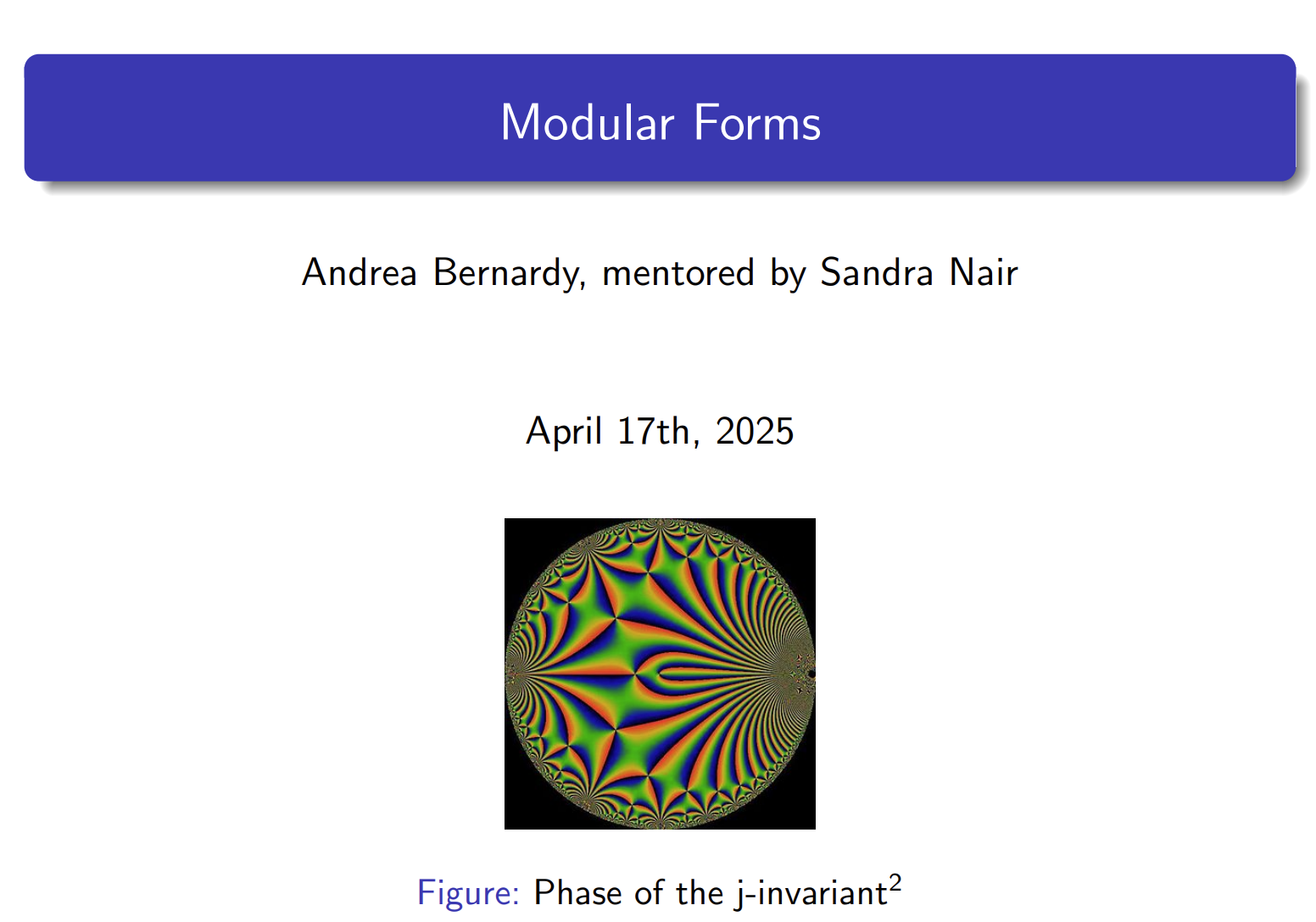
Modular forms have been at the forefront of some of the most interesting projects in mathematics in the last century. These forms are holomorphic functions that map from the upper half of the complex plane to the full complex plane by satisfying the modularity condition for SL2(Z) where SL2(Z) is the set of all 2x2 matrices with integer entries and determinant of one. S and T (and their inverses) in SL2(Z) are the generating matrices of the modular group SL2(Z) that allow for a function to be mapped from the Fundamental Domain of SL2(Z) in the upper half of the complex plane to the full upper half of the complex plane. This provides an inordinate amount of information about the function and objects surrounding it that has led to the famous proof of Fermat’s Last Theorem by Andrew Wiles as well as the Taniyama-Shimura Conjecture. These special functions have found a comfortable home in group theory with Moonshine Theory proposing a connection between these and the mythical Monster group and at the helm of the “grand unified theory of mathematics”, Langlands Program, which seeks to bridge algebraic number theory, representation theory, and geometry.