
How does inter-annual climate variation impact phenological cycles of Western Tanager (Piranga ludoviciana)?
Category: Research Poster
Author(s): Andie Hall
Presenter(s): Andie Hall
Mentors(s): Anping Chen, Stacy Lynn
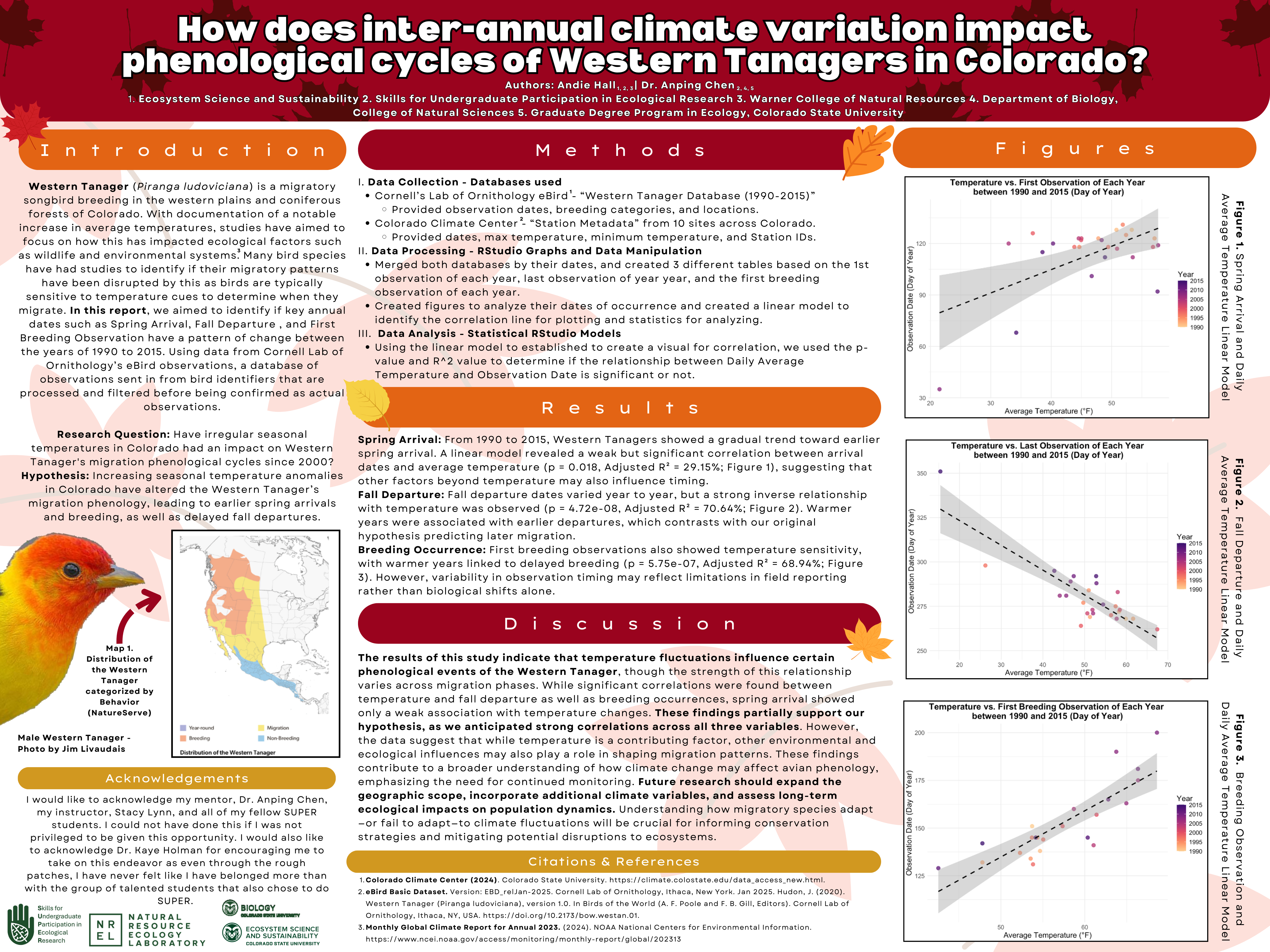
Western Tanager (Piranga ludoviciana) is a migratory songbird breeding in the western plains and coniferous forests of Colorado. This vibrant species’ migratory timings are sensitive to climate variation and thus can serve as an excellent model for examining the effects of climate change on avian migration. In particular, studies have documented shifts in multiple phenological phases of this species over recent decades, raising concerns about disruptions in breeding cycles and population dynamics. This research leverage thousands of observations in the eBird citizen science database, complemented with literature review, to investigates how variations in average temperatures may determine the first observation of key annual phenological events, including spring arrival, fall departure, and breeding periods. By conducting statistical data analysis through linear modeling in RStudio to identify variance in patterns and visualization of eBird records from 1990 to 2015 alongside daily average temperature data from Colorado State University’s Colorado Climate Center, we aim to identify trends in migration timing relative to temperature fluctuations. Understanding these patterns is crucial for predicting how climate change may impact species distribution, reproductive success, and long-term population stability. The finding of a somewhat cohesive correlation between daily average temperatures and arrival dates contributes to broader discussions on avian ecology and conservation efforts, providing insight into potential adaptive responses and informing future climate-related policy and management strategies.