
Exploring brain signals: neural excitability in the posterior hypothalamus of male and female rats
Category: Research Poster
Author(s): Kamalani Larson, Courtney Bouchet, Brent Myers
Presenter(s): Kamalani Larson
Mentors(s): Courtney Bouchet, Brent Myers
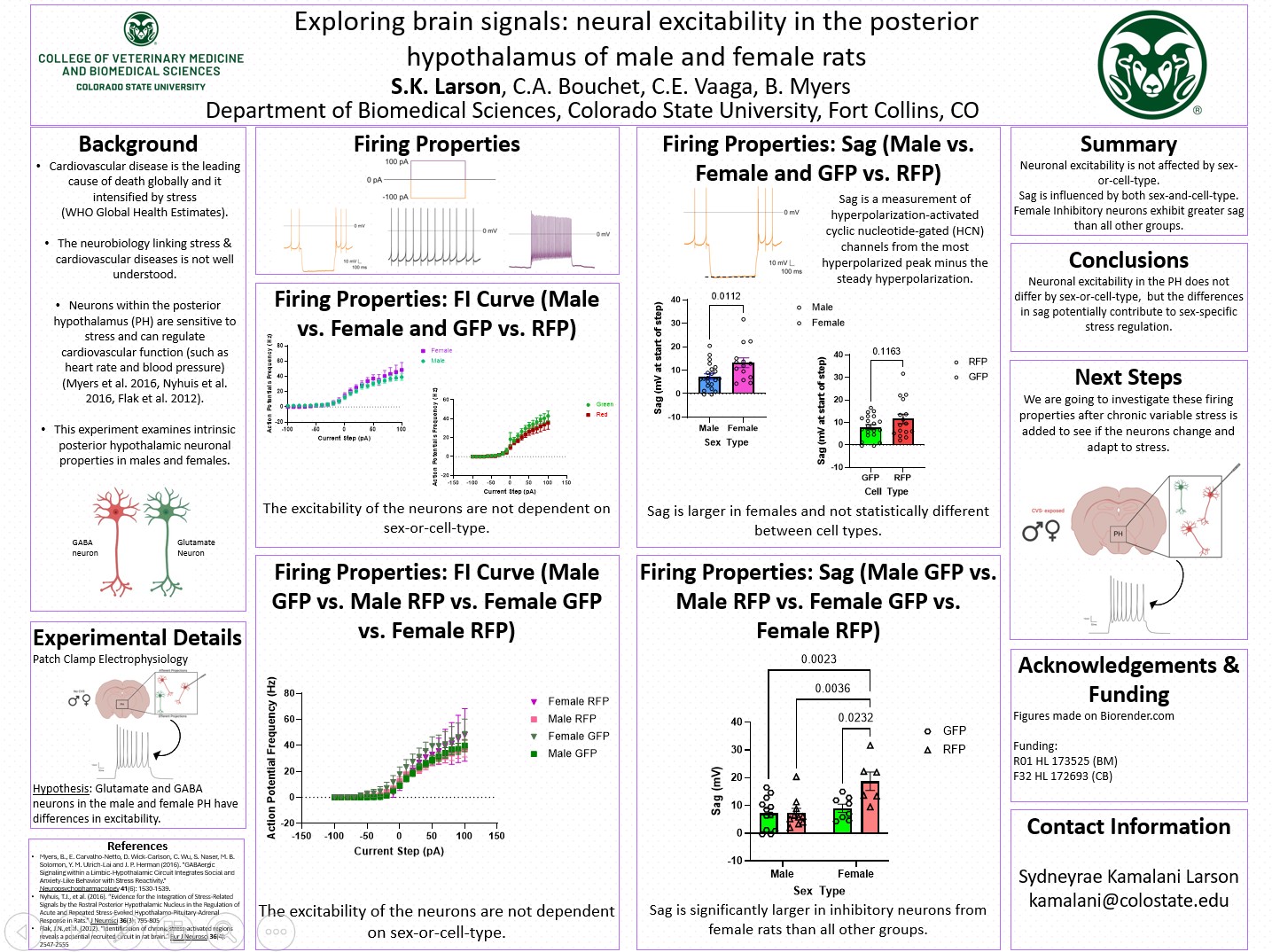
Cardiovascular diseases are the leading cause of death globally and are intensified by stress; however, the neurobiology linking stress and cardiovascular diseases is not well understood. Previous work in our lab indicates that neurons within a brain region called the posterior hypothalamus (PH) are sensitive to stress and can regulate cardiovascular function, such as blood pressure and heart rate. However, the characteristics of the neurons within the PH are not well understood and could be important in the differential susceptibility to stress-induced cardiovascular diseases. Therefore, the goal of this project is to investigate action potential firing properties of neurons within the PH. Male and female GAD-Cre transgenic Long-Evans rats received injections of a virus leading to red fluorescence in inhibitory, GABAergic neurons and green fluorescence in excitatory, glutamatergic neurons. Cellular properties were investigated using patch clamp electrophysiology, a method that measures electrical properties of neurons. Electrical current from -100 to +100 pA was injected into neurons to measure excitability and the presence of hyperpolarization-activated channels. These data indicate that neuronal excitability is not dependent on sex or cell-type. However, sag, a measure of hyperpolarization-activated channels, is dependent on both cell-type and sex, with female inhibitory cells exhibiting larger sag than all other groups. This project provides a deeper understanding of the properties of excitatory and inhibitory neurons in the PH and how they could play a role in stress-related diseases. This work was supported by NIH R01-173525 awarded to Dr. Brent Myers and NIH F32-HL172693 to Dr. Courtney Bouchet.